
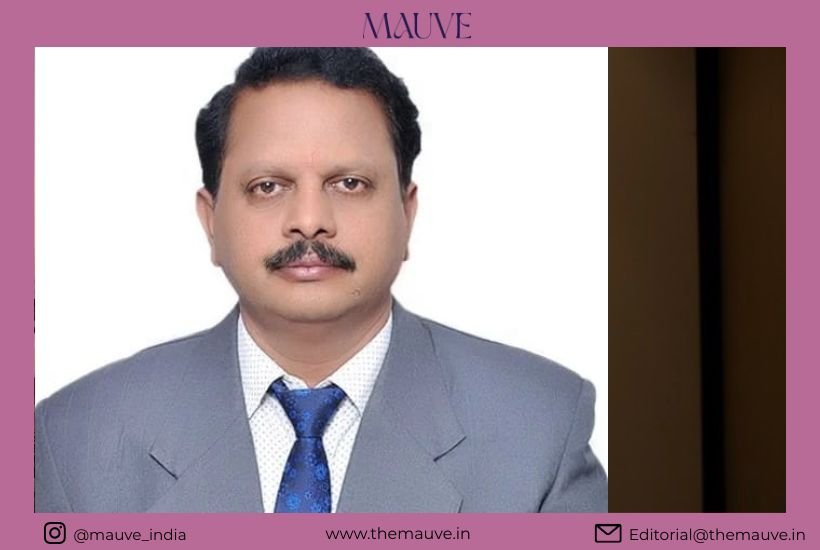
For Krishna Mohan Pinnaparaju, scarcity was never an abstract development statistic.
From Anantapur to a Life in Social Impact
He grew up in Anantapur, a drought-prone district where the absence of water, opportunity and security shaped everyday life. He saw families struggle not only with resources, but with the loss of dignity that often accompanies prolonged hardship.
Perhaps that is why his journey into the social sector began so early.
He started volunteering as a student and, by the age of 18, had committed himself fully to community work. More than 25 years later, his journey has taken him through grassroots organisations, government programmes, international assignments and four major disaster responses.
But behind that long professional journey is another constant: his wife and co-founder, Sailaja.
Her compassion and quiet conviction have remained an anchor throughout the years, eventually becoming part of the foundation on which they built UDS Foundation.
Why UDS Foundation Was Built Around Holistic Development
The organisation emerged from a simple but deeply considered realisation: poverty cannot be solved one problem at a time.
After spending more than two decades working within existing systems, Krishna felt the need to create an organisation capable of looking at the interconnected realities of people’s lives. Education could not be separated from healthcare. Healthcare could not be separated from livelihoods. Environment and disaster resilience could not be treated as peripheral concerns.
UDS Foundation was therefore built around a holistic approach spanning education, healthcare, skilling, environment and disaster response.
It began with just ₹1 lakh and a rented space.
But the ambition was never small.
“Dignity first.”
That became the philosophy.
For UDS, impact isn’t created by simply delivering a service and moving on. Every programme is designed alongside the communities it serves, measured through real outcomes and continuously refined through feedback from the ground.
Because a child who is hungry cannot learn.
A young person without health security cannot sustain a livelihood.
And a family pushed into financial distress by illness may lose years of progress.
The foundation’s work therefore looks beyond individual interventions towards the systems connecting them.
For Krishna, some of the most meaningful evidence of impact doesn’t appear in a presentation or annual report.
It appears in a mother’s voice when she says her daughter will now finish school.
It appears when a young person secures their first formal job.
It appears when a community begins to believe that its future can be different.
One moment, in particular, has remained with him.
During a disaster response, an elderly woman who had lost almost everything held his hand and told him that because the team had come, her grandchildren still believed tomorrow could be better.
The words stayed.
They also clarified something about the purpose of social work.
“Our work is about restoring hope.”
That philosophy challenges one of the most persistent misconceptions surrounding NGOs—that their role is primarily to distribute charity or fill gaps left by the state.
Krishna sees the work differently.
The real objective, he believes, is to transfer agency.
To help people develop the confidence, skills and collective voice to become authors of their own progress.
In that sense, the most successful programme is not necessarily the one that continues receiving support forever.
It is the one that eventually no longer needs the organisation to run it.
That belief has shaped UDS’s approach to partnerships as well.
For Krishna, CSR and community participation are not separate components of development. They are complementary forces.
Corporate partnerships can bring capital, expertise, systems and scale.
Communities bring something equally important: ownership, cultural understanding and long-term continuity.
“We never enter a village as saviours; we enter as partners.”
It is a distinction that defines the foundation’s philosophy.
Funding can accelerate a programme.
But ownership is what allows it to survive.
The same principle applies to how Krishna measures success.
For an organisation whose purpose isn’t profit, conventional financial metrics can only tell part of the story.
A young person from a drought-affected family finding stable employment.
A mother receiving timely healthcare.
A community planting trees and creating conditions that allow families to stay rather than migrate.
These are the foundation’s real balance sheets.
Numbers still matter, because accountability matters. But the deeper measure is whether people begin to believe in their own possibilities.
“Profit is easy to count. Lasting human transformation requires patience, honesty and the courage to stay long after the cameras leave.”
That patience has been tested.
There have been periods when resources were scarce and the scale of need felt almost impossible to confront. There were nights when Krishna questioned whether one organisation could genuinely make a difference.
What brought him back was evidence—not of perfection, but of possibility.
A healthcare intervention that prevented a family from falling deeper into financial distress.
An adolescent girl overcoming myths and misconceptions, returning to school and beginning to rewrite her future.
And, throughout those moments, the steady presence of Sailaja.
For Krishna, leadership in the social sector is therefore less about visibility and more about discipline.
He places humility, integrity and deep listening at the centre of his leadership philosophy.
“Empathy without discipline is sentiment; discipline without empathy is cold.”
It is a balance he has learned to protect over decades.
And it is perhaps why his advice to young people entering the development sector is not romantic.
Come with an open heart, he says—but come prepared.
Idealism alone cannot sustain someone through years of slow progress, difficult systems and invisible victories. The sector needs people willing to build rather than people looking to become heroes.
There is something particularly telling about the challenge Krishna would choose to solve over the next decade.
He points towards the silent exclusion of vulnerable children and adolescents, particularly girls, from quality education and basic healthcare.
Because exclusion rarely happens in isolation.
A girl kept out of school because of social myths loses more than an education. A family struggling with healthcare costs may lose its ability to keep children in school. One generation’s disadvantage can quietly become the next generation’s inheritance.
Connecting education, preventive healthcare and community awareness, he believes, can interrupt several cycles at once.
It can restore dignity.
It can keep children in school.
And it can give families something that development work often struggles to quantify—the breathing space to imagine a different future.
Ultimately, however, Krishna’s ambition for UDS Foundation extends beyond the organisation itself.
Its name, Udya Dbanu Sahasrabha, translates to “rising with the light of a thousand suns.”
And that becomes the most fitting metaphor for his vision.
He does not want UDS to be remembered simply as an organisation that did good work.
He wants it to be remembered as an organisation that helped people discover their own light.
“Long after we are gone, thousands of empowered individuals and communities should continue to shine—educating, healing, building livelihoods and protecting their environment, without needing us.”
Perhaps that is the most meaningful definition of social impact.
Not how many people an organisation can help while it is present.
But how many people are strong enough to keep building after it leaves.
Krishna Mohan Pinnaparaju, Co Founder, UDS Foundation


 anti-violence-792142 says: