What happens when two brands under the same parent company stop behaving like corporate siblings and start behaving like actual siblings? You get one of Raksha Bandhan’s most entertaining brand conversations.
Raksha Bandhan is usually a season of sentimental campaigns, sibling throwbacks and carefully scripted declarations of love. But this year, Zomato and Blinkit chose a very different route: sibling rivalry.
Instead of simply wishing consumers a Happy Rakhi, the two brands turned the festival into an ongoing family argument — first taking over a newspaper page, and then carrying the banter onto social media.
And honestly, it feels less like advertising and more like watching two siblings fight over the remote.
⸻
It Started With a Newspaper Page
The campaign’s cleverest move was perhaps its simplicity.
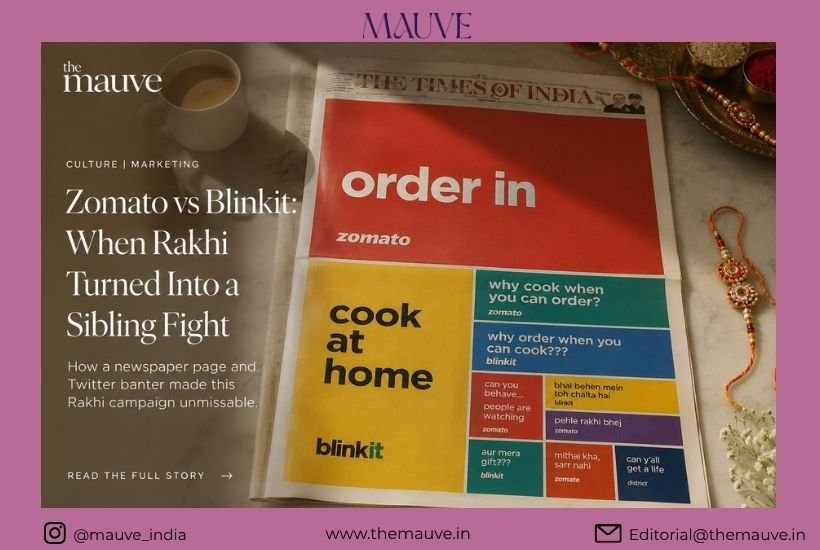
In a newspaper creative, Zomato took the lead with a bold red block reading:
“order in”
Underneath, the Zomato logo made the proposition clear: why cook when you can simply order?
But Blinkit wasn’t going to let its sibling have the last word.
The adjoining creative responded with:
“cook at home”
And from there, the newspaper page essentially became a sibling argument.
Zomato asked:
“why cook when you can order?”
Blinkit fired back:
“why order when you can cook???”
The rest of the page continued the conversation in smaller blocks, with each brand taking playful digs at the other.
There was even the familiar sibling complaint:
“bhai behen mein toh chalta hai”
followed by:
“pehle rakhi bheji”
and the inevitable:
“aur mera gift???”
It is a wonderfully Indian way of bringing Raksha Bandhan into advertising — not through an exaggerated emotional narrative, but through the petty, funny, recognisable conversations that actually happen between siblings.
⸻
From Newspaper to Twitter: The Fight Continues
The campaign didn’t stop with print.
On Twitter/X, Blinkit and Zomato extended the sibling narrative with another exchange.
Blinkit’s post cheekily declared:
“Adopted nahi acquired hota hai…”
Zomato’s response was equally simple:
“happy rakhi adopted sis”
The exchange works because the brands aren’t pretending to be competitors in the traditional advertising sense. Instead, they’re personifying themselves as siblings — complete with teasing, one-upmanship and the occasional insult disguised as affection.
And that distinction is important.
The joke isn’t simply Zomato vs Blinkit.
It is older sibling vs younger sibling.
⸻
The Genius Is in the Personification
Zomato and Blinkit already have distinct roles in consumers’ minds.
Zomato is associated with ordering meals.
Blinkit is associated with bringing groceries and everyday essentials to the doorstep.
The newspaper creative takes those two propositions and turns them into personalities.
Zomato: Why are you cooking? Just order.
Blinkit: Why are you ordering? Cook something yourself.
Suddenly, two product propositions become a family argument.
That is what makes the campaign memorable.
Rather than explaining Raksha Bandhan or telling consumers what sibling love means, the brands behave like siblings.
⸻
No Emotional Overkill. Just Familiar Indian Banter.
Festival advertising can sometimes become predictable: childhood photographs, parents getting emotional, siblings hugging, voiceovers about lifelong bonds.
Zomato and Blinkit avoided almost all of that.
There is no elaborate story.
No tearjerker.
No long-form film required to understand the joke.
Just:
“Why cook?”
“Why order?”
“Where’s my gift?”
“Adopted.”
“Acquired.”
And that is precisely why the campaign feels native to the festival.
Because anyone who has grown up with a sibling understands that affection doesn’t always sound like affection.
Sometimes it sounds like an argument.
⸻
The Newspaper Became the Family Group Chat
The print execution deserves particular attention.
Instead of treating the newspaper as three independent advertising spaces, the brands made the entire page feel like one conversation.
Zomato gets its big red visual.
Blinkit gets its yellow block.
The supporting colours and copy create the feeling of multiple voices interrupting each other.
It turns a traditionally static advertising format into something conversational.
You don’t just look at the advertisement.
You read it like a conversation.
And then you instinctively wait to see what the other sibling says.
⸻
Why the Twitter Extension Works
The social media continuation adds another layer to the campaign.
The newspaper creates the setup.
Twitter/X becomes the place where the siblings continue fighting.
That makes the campaign feel less like a single ad placement and more like an unfolding piece of brand entertainment.
The audience isn’t being asked to understand a complicated campaign proposition.
They’re simply being invited to pick a side.
Team Zomato or Team Blinkit?
And that is exactly the kind of low-friction interaction that makes social-first brand banter travel.
⸻
Advertising That Doesn’t Feel Like Advertising
The larger lesson from the Zomato-Blinkit Rakhi campaign is straightforward:
The most memorable brand advertising doesn’t always feel like advertising.
Here, the brands borrowed something consumers already understand — sibling teasing — and placed their own product propositions inside it.
The result is culturally familiar, visually distinctive and extremely shareable.
More importantly, the campaign gives both brands something valuable: a reason to talk about each other without making the conversation feel corporate.
It is playful competition without actual hostility.
Brand strategy disguised as sibling drama.
And perhaps the best part?
For once, the family member everyone is fighting over isn’t the favourite child.
It’s the consumer.
⸻
The Mauve Take
Zomato and Blinkit didn’t need to tell India that Raksha Bandhan is about sibling love. They simply showed us what sibling love actually looks like — petty arguments, unsolicited advice, accusations, comebacks and, somewhere underneath all of it, affection.
In a festival crowded with sentimental campaigns, making people laugh might just be the smarter way to make them remember you.