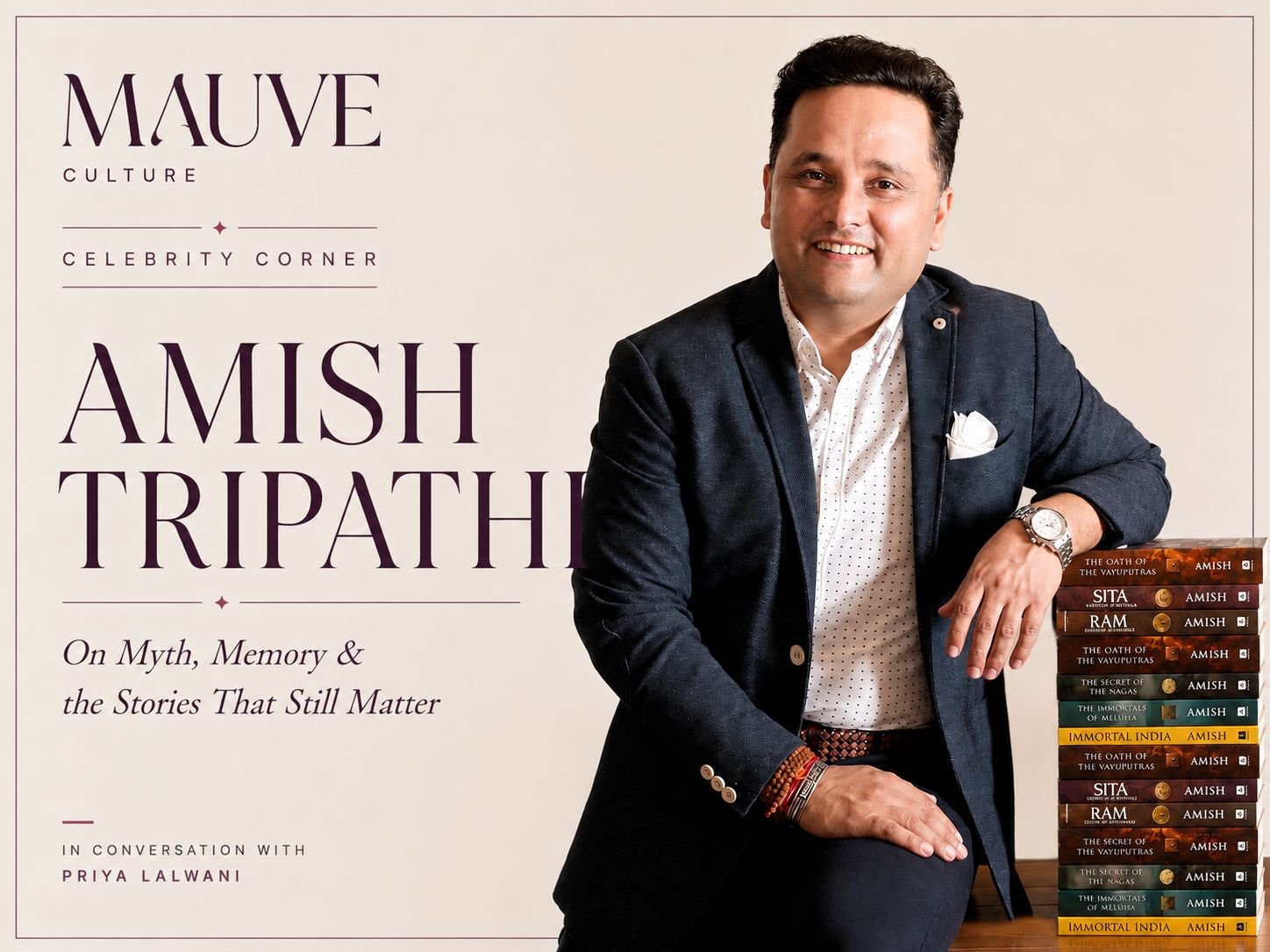
In conversation with Priya Lalwani, the bestselling author reflects on the Mahabharata, the meaning of Itihasa, the accident that made him a writer, and why the only way to defeat doomscrolling is to tell better stories.
Interview by Priya Lalwani
There are writers who create stories, and then there are writers who attempt to reopen civilisational memory.
For more than a decade, Amish Tripathi has occupied that unusual space in Indian publishing. His books have taken gods out of distant temples and placed them within deeply human worlds—worlds shaped by ambition, morality, politics, grief, loyalty and choice.
From the Shiva Trilogy to the Ram Chandra Series, Amish has built a literary universe where mythology is not treated as fantasy, but as a living archive of philosophical thought.
Yet, when Priya Lalwani sat down with the author, the conversation quickly moved beyond books.
It became a discussion about how India understands its past, why the mythology-versus-history debate may be fundamentally misplaced, how a banker unexpectedly became one of the country’s most successful writers, and whether books can still compete with the infinite scroll.
The result was not simply an interview about literature.
It was a conversation about culture, attention and the stories a civilisation chooses to remember.
⸻
The Mahabharata Is Coming—But Not in a Hurry
For readers who have followed Amish’s work closely, one question continues to return: when will he write the Mahabharata?
The author has often spoken about the epic’s scale, complexity and relevance. It remains one of India’s most layered narratives—a story without easy heroes, simple villains or uncomplicated moral victories.
When asked whether his frequent references to the Mahabharata were leading towards a long-awaited dream project, Amish responded with characteristic humour.
“I do hope and plan to write about the Mahabharata soon. But yaar, this is my thirteenth book in sixteen years. Isse jaldi likhna thoda mushkil hai, yaar. Bachche ki jaan loge?”
He confirmed that the idea already exists.
“I will come out with the Mahabharata too, but it will take some time. I do have a story idea in mind, and I hope to write that as well—certainly.”
For a writer whose novels frequently engage with moral conflict, political power and personal dharma, the Mahabharata feels almost inevitable.
But it is also perhaps the one Indian epic that cannot—and should not—be rushed.
⸻
Mythology, History and the Word India Already Had
One of the most compelling moments of the conversation emerged when Priya asked how much of mythology is myth and how much of it is reality.
Amish’s answer dismantled the question itself.
He began with the Greek origin of the word mythology.
“The root of the English word ‘mythology’ is a Greek word called mythos.”
He explained that mythology is often understood today as an exaggerated or fanciful story that may contain fragments of truth. But the older meaning of mythos, he noted, was far more philosophical.
“The Greek word mythos actually means a story that hides a philosophical truth.”
This distinction lies at the heart of how Amish approaches Indian epics.
The purpose of a story, in this view, is not merely to document events. It is to contain an idea larger than the event itself.
“The story itself is important, but what is even more important is learning the philosophy contained within it.”
For generations, Indian narratives have been forced into imported categories—history on one side, mythology on the other. One is assumed to be factual and therefore serious; the other, symbolic and therefore less real.
Amish rejects that binary.
“The British Raj had this belief that their traditions were history, while ours were mythology—which obviously makes us angry.”
India, he reminded us, already had its own word: Itihasa.
“Itihasa simply means, ‘Thus, it happened.’”
The word does more than describe the past. It reflects a distinctly Indian way of engaging with memory—one that is less obsessed with dates and more interested in meaning.
“Our ancestors were more focused on learning lessons from the past rather than getting into a list of dates.”
His conclusion was direct.
“Getting into the debate of mythology versus history is a stupid debate. That is a Western debate, and I do not even want to get into it.”
Instead, Amish argues that Indian stories should be approached as living philosophical texts.
“What matters to us is that all of this is Itihasa. Our job is to learn the philosophical lesson and apply it to our lives today.”
In an age when identity is increasingly debated through hashtags, fragments and outrage, this perspective offers something slower and more enduring: the idea that culture survives not by proving every story, but by continuing to learn from it.
⸻
The Banker Who Never Planned to Become a Writer
Amish Tripathi’s career is now inseparable from the rise of Indian mythological fiction.
But the author insists there was no elaborate literary strategy behind it.
Before the books, there was banking.
“I was not looking to become a writer. I was a banker. It is a boring job, but it pays very well.”
The honesty is revealing because it resists one of the most common myths surrounding creative success: that every celebrated career began with a perfectly articulated dream.
Amish did not begin with a publishing plan, a personal brand or a calculated attempt to reinvent Indian mythology.
He began with an idea.
“This idea struck me, and I wrote it just for myself.”
He did not expect the manuscript to become a cultural phenomenon.
“I did not even think it would get published, let alone become a bestseller.”
The Shiva Trilogy would eventually become one of the defining publishing successes of contemporary India.
Yet Amish continues to describe its journey in spiritual rather than strategic terms.
“It is Lord Shiva’s blessing.”
When asked what inspired him to imagine Shiva in a deeply human form, his response remained refreshingly uncomplicated.
“There was no strategy—nothing.”
He followed the story rather than the market.
“I simply followed my heart. I followed Lord Shiva, and the story emerged.”
It is an important admission in a creative economy increasingly driven by metrics, algorithms and trend forecasting.
Sometimes, the work that reaches millions begins without any certainty that it will reach even one.
⸻
The Battle for Attention
The final part of the conversation moved from ancient stories to one of the most modern anxieties: doomscrolling.
Can books still command attention in a world designed to interrupt it?
Can history compete with notifications?
Can a long-form story survive beside the endless feed?
Amish does not dismiss technology entirely. Phones, he acknowledges, offer unprecedented access to information. The problem begins when access turns into dependency.
“Phones give you access to knowledge, which is good. But aap yaar chaar-chaar ghante bas aise hi scroll kare jaa rahe ho—doomscrolling—it is not good for your mind.”
He also pointed to an uncomfortable contradiction within the technology industry.
“You will also notice that many of the owners of social media companies do not allow their children to be on social media.”
For Amish, that should immediately make parents and young people pause.
“The people who have got you addicted to phones do not allow their own children to use social media because they know the impact that doomscrolling has on the mind.”
Yet he does not advocate for bans or fear-driven parenting.
Instead, he offers a far more demanding solution: create something better.
“What we have to do as adults is make other things interesting for our children.”
Children, he suggests, will not disconnect simply because they are instructed to. They will disconnect when something else captures their imagination more completely.
“So, write a book that is hopefully so interesting that they forget about their phone.”
To illustrate the point, Amish turned to cinema.
“Many children, when they are watching Dune, do they think about their phone? No, right?”
Then came the line that could easily become the internet’s favourite quote from the conversation:
“Doomscrolling se Dune-watching ho jaata hai!”
The humour carries a serious cultural challenge.
The enemy is not always the screen.
The enemy is boredom.
The real task before writers, filmmakers, educators and cultural institutions is not merely to condemn distraction. It is to produce work powerful enough to defeat it.
“You have to make something so interesting that they put their phone aside.”
That is the challenge.
And perhaps it is also the future of storytelling.
⸻
A Culture Must Be Interesting Enough to Survive
Amish Tripathi’s work has always existed at the meeting point of the ancient and the contemporary.
His characters come from civilisational memory, but they speak to modern dilemmas. His stories are rooted in epics, but they examine governance, masculinity, morality, freedom, justice and leadership.
The conversation with Priya Lalwani revealed the larger philosophy behind that work.
India does not need to choose between myth and history.
It does not need to imitate the language through which other cultures classify their past.
And it does not need to abandon its stories simply because attention spans are changing.
What it needs is to tell those stories with urgency, intelligence and imagination.
Because culture does not survive only because it is old.
It survives because every generation finds a reason to return to it.
Amish’s argument, ultimately, is not that young people have stopped caring about stories.
It is that storytellers must work harder to deserve their attention.
In a world of endless scrolling, the future may belong to the story that makes us stop.
⸻
Mauve Takeaway
Amish Tripathi’s literary success is often described through numbers, bestsellers and publishing records.
But his deeper cultural influence lies elsewhere.
He has made Indian readers look again at stories they thought they already knew.
He has challenged the distinction between mythology and historical memory.
And he has demonstrated that ancient narratives do not need to be simplified to become popular—they need to be made alive.
Perhaps that is why his work continues to resonate.
He does not ask readers to escape the present.
He asks them to use the past to understand it.
⸻
Pull Quotes
“The Greek word mythos actually means a story that hides a philosophical truth.”
“What matters to us is that all of this is Itihasa.”
“There was no strategy—nothing. I simply followed my heart.”
“Write a book that is hopefully so interesting that they forget about their phone.”
“Doomscrolling se Dune-watching ho jaata hai!”
“You have to make something so interesting that they put their phone aside.”