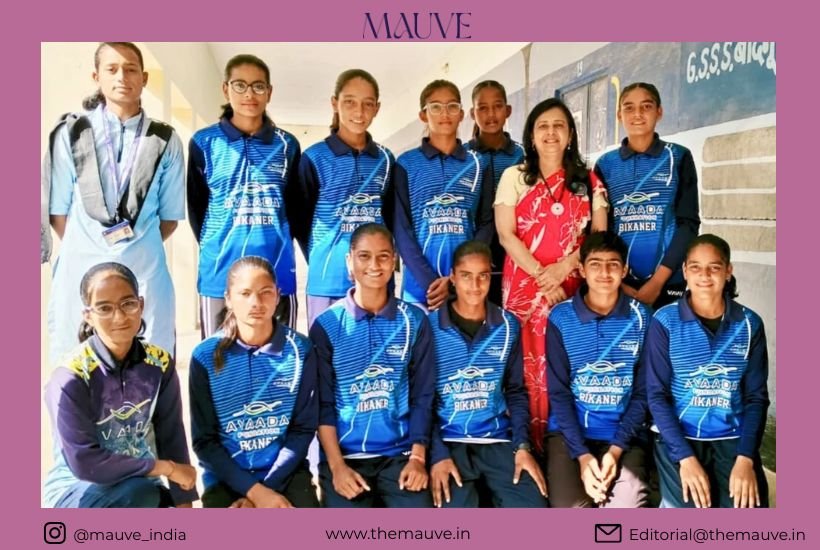
From village grounds in Rajasthan to state championships, national medals and trials with Delhi Capitals Women, the young cricketers of Badnu are showing what becomes possible when talent meets opportunity.
In Badnu, a small village in Rajasthan, cricket is becoming more than a sport.
For a group of young girls from Mahatma Gandhi Government School, Badnu, the cricket field has become a place to challenge expectations, build confidence and imagine a future that extends far beyond the boundaries of their village.
Their journey — from local grounds to state championships, national tournaments and opportunities connected to professional cricket — is at the centre of Avaada Foundation’s latest campaign, “Badnu Ke Champions: Ghoonghat Se Helmet Tak.”
The title itself captures the transformation. The journey from the traditional ghoonghat to a cricket helmet represents more than a change in what these young women wear. It reflects a growing confidence to step forward, compete and pursue ambitions on their own terms.
When Talent Gets a Chance
For rural athletes, talent is often only the beginning.
Travel, equipment, tournament fees, nutrition, accommodation and access to proper training can determine whether a promising young player gets to continue or is forced to step away from the sport.
For the Badnu girls, the Avaada Foundation, the social impact arm of Avaada Group, has attempted to address some of these barriers.
The Foundation has supported the Rajasthan State-Level Under-17 and Under-19 Girls’ Cricket Teams from Badnu for two years and has renewed the partnership for a third consecutive year.
Its support covers a wide range of expenses, including travel, accommodation, food and nutrition, sports kits, shoes, cricket equipment, tournament fees and practice facilities. Educational and logistical support is also provided.
The idea is simple: a lack of financial resources should not determine how far a talented young athlete can go.
Seven Girls. One State Championship.
The results have begun to speak for themselves.
Seven girls from Badnu played an important role in helping the Bikaner team win both the district-level tournament and the 69th Rajasthan State-Level Cricket Tournament, securing the Rajasthan state championship title.
For Kanchan, the journey continued beyond the state level.
She went on to represent Rajasthan at the National Championship in Rohtak, Haryana, where her contribution helped the team secure a Silver Medal.
It is the kind of progression that can fundamentally change how a young athlete sees her own possibilities — from representing a school or district to seeing herself on a national sporting stage.
The Under-19 Team Steps Up
The achievements continued in the Under-19 category.
Six players from Badnu contributed to the team’s performance at the state-level tournament in Balotra, Barmer, where Rajasthan finished as runner-up and qualified for the National Championship in Shivpuri, Madhya Pradesh.
Among the standout performers was Sarita, who was recognised as the tournament’s Best Bowler and subsequently represented Rajasthan at the national level.
At the national stage, the Badnu players added more medals to their growing record.
Sangeeta secured a Bronze Medal, while Kanchan won Silver.
For girls who began their cricket journeys on village and school grounds, these medals represent more than sporting achievements. They are evidence of what can happen when rural talent is given a pathway to compete.
From Badnu to Delhi Capitals
Perhaps one of the most significant milestones came when five young cricketers from Badnu were selected for trials for an opportunity to serve as net bowlers for the Delhi Capitals Women’s Premier League team.
For a young athlete, simply entering that environment can be transformative.
The experience offers exposure to a professional sporting ecosystem and provides a glimpse into the standards, discipline and intensity associated with elite cricket.
The journey from village grounds to a professional cricket platform is precisely what makes the Badnu story resonate beyond the scoreboard.
The Meaning Behind ‘Ghoonghat Se Helmet Tak’
The Avaada Foundation campaign takes its name from the contrast at the heart of these girls’ journeys.
The ghoonghat represents the social expectations and traditional boundaries that many young women in rural communities may encounter.
The cricket helmet represents something else: participation, confidence, competition and visibility.
The campaign does not simply celebrate cricketing victories. It attempts to capture a wider transformation — young women gaining the confidence to step into spaces where they may not have traditionally been represented.
For Vineet Mittal, Chairman, Avaada Group, sport can become a catalyst for inclusion, confidence and social change, particularly for girls in rural communities.
The objective, he said, is not only to create sporting champions but to nurture leadership and confidence among a generation of young women.
Beyond the Boundary
For Ritu Patwari, Director and CSR Head, Avaada Foundation, the journey has been particularly personal.
Having followed the girls’ progress at the grassroots level, Patwari says she has witnessed their development not only as cricketers but as increasingly confident young women navigating social and financial barriers.
That distinction matters.
A sporting programme can produce medals. But its longer-term impact can lie in something less measurable — a girl believing that her ambitions deserve space.
A girl travelling outside her village for a tournament.
A girl representing her state.
A girl walking into a professional cricket environment.
A girl becoming an example for the next generation watching from the boundary.
A New Generation Taking the Field
India’s women’s cricket has already created a powerful national conversation around what young girls can achieve through sport. The story of Badnu adds another dimension to that movement.
Not every aspiring cricketer begins at a prestigious academy or has access to elite facilities.
Some begin on school grounds, village pitches and community fields.
What changes the trajectory is often the opportunity to go further.
The girls of Badnu are doing exactly that — one match, one medal and one opportunity at a time.
Their story is ultimately bigger than cricket.
It is about what happens when circumstance stops being the final word on a young woman’s future.
From ghoonghat to helmet, from village grounds to national arenas — Badnu’s daughters are showing that ambition has no postcode.