
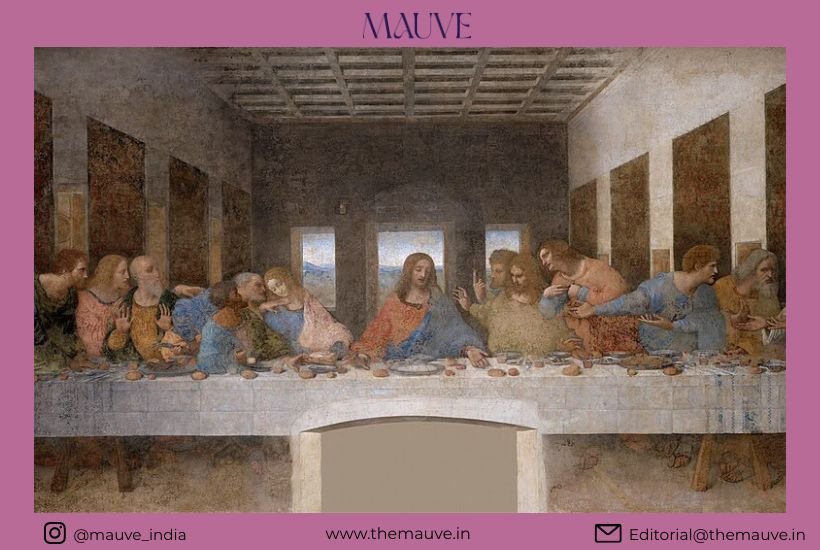
11 Fascinating Secrets Behind the World’s Most Mysterious Painting
Some masterpieces are admired for their beauty. Others are remembered for their history. Leonardo da Vinci’s The Last Supper is celebrated for something far rarer—it continues to spark curiosity, conversation, and countless interpretations over five centuries later.
As the opening feature of The Art Vault, Mauve’s new editorial series exploring iconic works of art, we begin with one of history’s most extraordinary masterpieces. Painted between 1495 and 1498, The Last Supper is far more than a religious mural—it is a timeless study of emotion, symbolism, design, architecture, perspective, and human psychology.
Every detail, from the placement of a hand to a spilled pinch of salt, has inspired generations of artists, historians, musicians, and scholars. Whether you’re discovering the artwork for the first time or revisiting it through a different lens, here are the fascinating stories and hidden details that make The Last Supper one of the most analysed paintings in the world.
- Leonardo Captured a Single Moment That Changed History
Unlike earlier depictions of the biblical feast, Leonardo chose to paint the exact moment when Jesus tells his disciples:
“One of you will betray me.”
Instead of stillness, the room erupts into emotion. Every apostle reacts differently—some question, some protest, some retreat into silence—while Christ remains calm at the centre, creating one of the most dramatic scenes in Renaissance art.
- The Perfect Triangle at the Heart of the Painting
Jesus is positioned at the centre of the composition, his body forming an almost perfect equilateral triangle—a symbol long associated with harmony, divinity, and the Holy Trinity.
Leonardo’s mastery lies in making geometry feel emotional. Even before the viewer consciously notices it, every visual element naturally leads the eye back to Christ.
- A Masterclass in Renaissance Perspective
One of the reasons The Last Supper feels so immersive is Leonardo’s extraordinary use of one-point linear perspective.
The ceiling beams, walls, windows, and architectural lines all converge behind Christ’s head, creating remarkable depth and making viewers feel as though they are standing inside the dining hall themselves.
Interestingly, historians believe Leonardo used a hammer, nail, and stretched strings to map this perfect perspective before he even began painting.
- Every Apostle Has a Different Emotional Response
Perhaps the painting’s greatest achievement is its humanity.
Rather than portraying twelve identical expressions, Leonardo transformed each disciple into an individual personality. Shock, disbelief, fear, anger, confusion, denial, and sorrow unfold simultaneously, making the painting feel almost cinematic centuries before cinema existed.
- Judas Is Hidden in Plain Sight
Among the disciples, Judas Iscariot immediately feels different.
His face falls into shadow.
He leans backwards.
His hand clutches a small purse containing the silver coins of betrayal.
In front of him lies an overturned salt cellar—a detail many interpret as a symbol of broken trust and impending misfortune.
Leonardo never explicitly points to the betrayer.
He lets body language tell the story.
- The Bread and Wine That Changed Christianity
The meal itself is remarkably simple.
Bread.
Wine.
Nothing extravagant.
Yet these humble elements became the foundation of the Christian Eucharist, symbolising Christ’s body and blood. Leonardo transforms an ordinary dinner into one of the most significant spiritual moments in history.
- The Mystery of the Fish
Art historians continue to debate one curious detail—the fish placed on the table.
Is it eel?
Or herring?
The answer matters because of subtle linguistic symbolism in Italian, where each carries different religious associations. While no consensus exists, this tiny detail demonstrates Leonardo’s fascination with layered meaning.
- A Pomegranate Full of Symbolism
Among the food rests another intriguing element—a pomegranate.
Often associated with sacrifice, resurrection, and eternal life in Christian art, its crimson seeds are widely believed to symbolise the blood Christ would soon shed.
Even the fruit on Leonardo’s table contributes to the story.
- Is There Another Painting Hidden Inside?
In 2007, computer analyst Slavisa Pesci digitally mirrored and superimposed The Last Supper, claiming to discover hidden imagery within the composition.
His interpretation suggested the appearance of a woman holding a child, a possible Knight Templar, a chalice, and even what he believed to be Leonardo’s self-portrait.
While art historians remain sceptical and regard these findings as speculative, the theory only added to the enduring fascination surrounding the masterpiece.
- Did Leonardo Hide Music in the Painting?
Another captivating theory emerged when Italian musician Giovanni Maria Pala suggested that the placement of the apostles’ hands and loaves of bread could be read as musical notes.
Following Leonardo’s habit of reading from right to left, Pala reconstructed a haunting 40-second melody inspired by the composition.
Whether intentional or coincidental remains unknown—but it beautifully reflects Leonardo’s genius as an artist, scientist, inventor, and musician.
- A Masterpiece That Almost Didn’t Survive
Ironically, The Last Supper began deteriorating only years after it was completed.
Rather than painting as a traditional fresco, Leonardo experimented with pigments on dry plaster—a technique that failed over time.
The mural has since endured centuries of moisture, neglect, repeated restorations, wartime damage, and even World War II bombings.
Today, only fragments of Leonardo’s original paint remain, yet its emotional power continues to captivate millions.
Why The Last Supper Still Captivates the World
Few works of art have inspired as many interpretations as Leonardo da Vinci’s The Last Supper.
It is a masterpiece of Renaissance design, a study in psychology, an architectural marvel, a lesson in perspective, and a timeless meditation on faith, friendship, sacrifice, and betrayal.
Perhaps its greatest mystery isn’t whether hidden messages exist within the painting.
Perhaps it’s the fact that, after more than five hundred years, the world still can’t stop looking.
And maybe that is exactly what Leonardo intended.
The Art Vault by Mauve
The Art Vault is Mauve’s editorial series celebrating iconic masterpieces, legendary artists, visionary photographers, and extraordinary works of creativity that continue to influence art, culture, design, and luxury across generations.