From global luxury brands embracing Indian heritage to international celebrities choosing Indian designers, fashion is entering an era where culture, craftsmanship and identity are becoming the new luxury.
There are two very different conversations happening in fashion today.
One is about authenticity, cultural appropriation and credit — who borrowed from whom, who owns a particular craft, and whether global luxury brands are giving enough recognition to the cultures that inspire them.
The other is far more exciting.
Indian couture is going global.
And perhaps it is time we looked at that side of the story a little more closely.
Because while international luxury houses are increasingly looking towards India’s heritage, craftsmanship and cultural vocabulary, global celebrities are also beginning to choose Indian fashion designers for their most significant fashion moments.
One recent example captures this shift beautifully: Chinese singer and performer Liu Yu wearing Manish Malhotra couture from MĀA — Paris Haute Couture Collection 2026.
And it is more than just a celebrity wearing an Indian designer.
It is a picture of where global fashion is heading.
Liu Yu in Manish Malhotra’s MĀA Couture
The look is almost dreamlike.
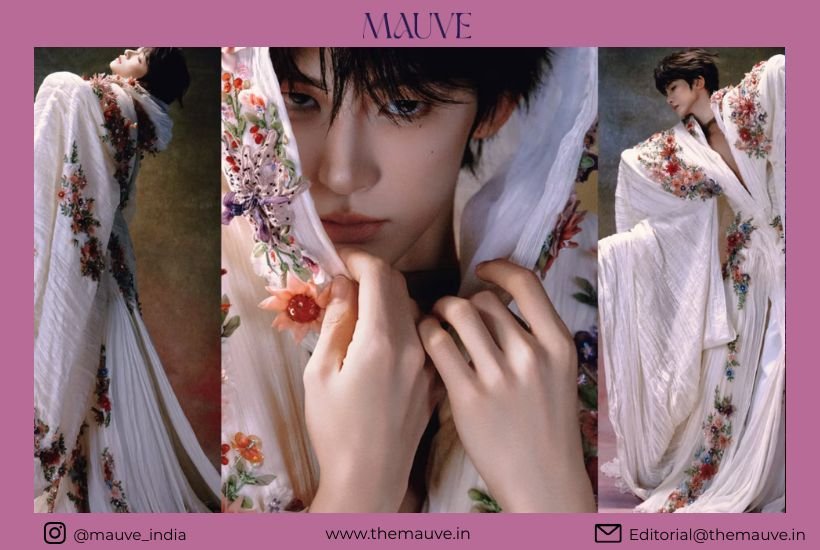
An expansive ivory silhouette falls around Liu Yu in layers of lightweight, flowing fabric. Oversized sleeves extend dramatically from the body, creating an almost wing-like effect, while a hood frames his face.
Then come the flowers.
Delicate clusters of pink, red, orange, peach and green bloom against the ivory canvas, appearing strategically along the shoulders, lapels, waist and long flowing panels. The embroidery adds colour without overwhelming the garment. (NDTV)
There is an unusual tension in the look.
It is maximalist craftsmanship expressed through minimalist styling.
Liu Yu wears no statement jewellery. His styling remains understated, allowing the couture to become the entire visual statement.
The result is romantic, theatrical and ethereal.
Almost as though he has stepped into a dream.
And that is perhaps what makes the look so compelling.
The garment does not simply sit on Liu Yu.
It seems to move with him.
A Chinese Artist, an Indian Designer and Paris Haute Couture
The symbolism is difficult to miss.
Liu Yu is Chinese.
Manish Malhotra is Indian.
The garment comes from MĀA, Malhotra’s deeply personal Paris couture collection, and the moment places Indian couture within an international fashion conversation. Malhotra presented MĀA at Paris Haute Couture Week in July 2026, becoming the fourth Indian designer to appear on the official calendar after Rahul Mishra, Gaurav Gupta and Vaishali S. (Vogue)
The collection itself was rooted in the designer’s relationship with his mother and unfolded through four chapters — Cocoon, Bond, Becoming and Abundance — transforming memory, protection, identity and legacy into couture. (Vogue)
Which makes Liu Yu wearing one of its most ethereal looks even more interesting.
A collection born from something deeply personal has now travelled across geography and culture.
And that is the power of fashion at its best.
The World Is Chasing Culture
Look at luxury fashion today and there is a larger movement happening.
Culture is becoming luxury.
Heritage is becoming luxury.
Craftsmanship is becoming luxury.
Provenance is becoming luxury.
The question is no longer only whether something looks expensive.
People increasingly want to know where it comes from, who made it and what story sits behind it.
And global luxury houses are responding.
Louis Vuitton has explored India’s influence on clothing and culture through its recent menswear work. Dior’s recent haute couture has also drawn from Indian craft-inspired artistic references, including chintz and jewellery influences associated with Rajasthan. (LVMH)
Prada, meanwhile, has moved beyond simply referencing the traditional Kolhapuri chappal, launching a Made in India project involving Indian artisans and an artisan-training programme. (PradaGroup)
And perhaps most significantly, Indian craftsmanship is beginning to step out from behind the scenes.
For decades, Indian ateliers have supplied embroidery and textile expertise to some of the biggest names in global luxury. Chanakya International, for example, has produced intricate work for Dior, Prada and Fendi. In 2026, its own label, Chorus, is attempting to take that expertise into the world as an Indian brand in its own right. (Vogue)
That is a significant shift.
The world has known Indian craftsmanship for decades.
Now it is increasingly discovering Indian fashion.
From Indian Craftsmanship to Indian Couture
There is an important difference between the two.
Indian artisans working behind the scenes of a European luxury house is one story.
A global celebrity deliberately choosing an Indian couture designer is another.
The first says:
Indian craftsmanship has value.
The second says:
Indian fashion has cultural and luxury value.
And that distinction matters.
For years, Indian designers have had to negotiate an industry where European fashion capitals were treated as the ultimate arbiters of luxury.
Paris.
Milan.
London.
New York.
But Indian designers are increasingly entering these conversations not as outsiders looking in, but as designers with their own visual language, craft histories and creative authority.
Manish Malhotra’s Paris couture debut is part of that larger evolution.
So are the international journeys of designers such as Rahul Mishra, Gaurav Gupta and Vaishali S.
The question is no longer whether Indian fashion can participate in global luxury.
It already is.
The bigger question is how far it can go.
India Doesn’t Have to Invent Heritage
This may be India’s greatest advantage.
The world is currently searching for authenticity.
India doesn’t have to manufacture it.
It already exists in our textiles, embroidery, jewellery, architecture, draping traditions, regional crafts and centuries-old artisanal practices.
From zardozi and chikankari to Banarasi weaving, Kanjeevaram silk, Indian block printing and intricate hand embroidery, India’s fashion vocabulary is extraordinarily diverse.
But heritage alone does not create contemporary luxury.
It needs interpretation.
It needs design.
It needs storytelling.
It needs brands that can take something deeply rooted in India and make it desirable in Paris, Shanghai, Seoul, London, Dubai or New York without stripping it of its identity.
That is the opportunity in front of Indian fashion today.
Not to become more Western.
But to become more confident about being Indian while speaking a global design language.
Beyond the Authenticity Debate
None of this means conversations around cultural credit should disappear.
They shouldn’t.
Authenticity matters.
Artisan recognition matters.
Cultural ownership matters.
And when traditional Indian crafts enter the global luxury system, the communities behind those crafts should benefit from the value they create.
But perhaps the conversation doesn’t always have to end in outrage.
There is another possibility.
We can acknowledge the complicated conversations while also celebrating what is happening in front of us:
Indian culture is becoming increasingly desirable in global luxury.
Indian craftsmanship is being sought after.
Indian designers are entering Paris.
Indian textiles are inspiring international collections.
Indian artisans are collaborating with global maisons.
And global celebrities are wearing Indian couture.
That is worth celebrating.
The New Luxury Is Rooted
Perhaps this is the larger cultural shift taking place.
For decades, luxury was about exclusivity.
Then it became about logos.
Then scarcity.
Now, increasingly, luxury is about meaning.
A garment with a story.
A textile with a lineage.
A craft with a community.
A designer with a point of view.
A piece that tells you something about where it came from.
In a world where fashion can sometimes feel increasingly homogenised, identity itself is becoming luxurious.
And India is exceptionally well positioned for that future.
Because our heritage isn’t something we need to create for a campaign.
It is already around us.
The opportunity is to translate it.
To elevate it.
To protect it.
And to take it to the world.
And Then There Is Liu Yu
Perhaps that is why the image of Liu Yu in Manish Malhotra feels bigger than a celebrity fashion moment.
A Chinese artist.
An Indian couture designer.
A Paris Haute Couture collection.
An ivory silhouette.
Flowers blooming across the garment.
Minimal styling against maximal craftsmanship.
And a piece of Indian couture being worn by someone from another culture — without the garment losing the creative identity of the designer who made it.
That is the beauty of fashion.
Culture can travel without disappearing.
It can evolve without becoming unrecognisable.
It can be interpreted without losing its roots.
And perhaps Indian fashion is finally entering that phase.
The world is looking for heritage.
The world is looking for craftsmanship.
The world is looking for cultural identity.
The world is looking for something that makes luxury feel human again.
India doesn’t have to look far.