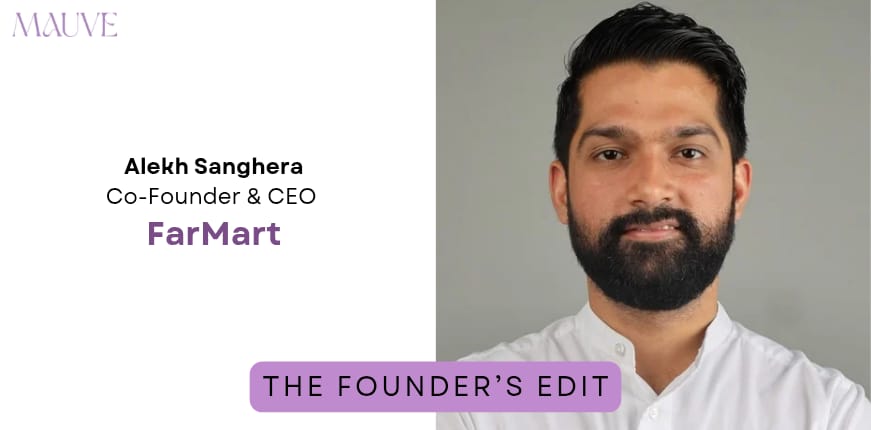
For the Co-founder and CEO of FarMart, the future of Indian agriculture isn’t just about growing better crops—it’s about building smarter supply chains, faster payments, and technology that restores trust across the entire ecosystem.
By Journalist Priya Lalwani
India’s agricultural conversation has traditionally revolved around what happens on the farm—better seeds, improved irrigation, higher yields, and increased productivity. But Alekh Sanghera, Co-founder and CEO of FarMart, believes the country’s biggest agricultural challenge begins only after the harvest.
For him, the real inefficiencies lie in procurement, logistics, quality verification, payments, and the fragmented infrastructure connecting farmers to buyers.
At The Founder’s Edit, Alekh Sanghera shares how a conversation with his grandfather, years spent working alongside farmers, and multiple failed business models ultimately led to building one of India’s fastest-growing AI-powered agricultural supply chain platforms.
FarMart’s story begins with two seemingly unrelated moments.
The first was deeply personal.
Sanghera’s grandfather, who had spent more than six decades farming near Jalandhar, shared a quiet observation that left a lasting impact. Despite India’s rapid economic progress, he felt farming had become an increasingly unprofitable and underappreciated profession.
The second came while Sanghera was conducting field research in western Uttar Pradesh for the Gates Foundation.
As he studied how farmers accessed government subsidies, he discovered that many were spending between 25 and 50 percent of their production costs simply renting agricultural machinery.
Neither the land nor the farmers were the problem.
The inefficiencies surrounded everything else.
Together, those experiences convinced him that meaningful change would require rebuilding the agricultural ecosystem from within rather than designing solutions from a distance.
Starting FarMart meant leaving behind certainty.
Both Sanghera and his co-founder, Mehtab, walked away from promising corporate careers—at MicroSave and Goldman Sachs respectively—to begin building in rural Uttar Pradesh, far from the conventional startup ecosystem.
The journey was anything but straightforward.
The company survived two failed business models, withdrawn term sheets, financial uncertainty, and prolonged periods of personal and professional adversity.
Yet throughout those setbacks, one principle remained constant.
They refused to lose proximity to the people they were building for.
Whenever the business encountered uncertainty, instead of retreating into spreadsheets or investor presentations, the founders returned to the field.
Listening to farmers, traders, and supply chain operators became their most valuable decision-making tool—a discipline that continues defining FarMart today.
One misconception about Indian agriculture is something Sanghera enjoys challenging.
Most discussions focus almost exclusively on farming itself.
In reality, he argues, much of agriculture’s inefficiency exists after crops leave the field.
Aggregation, storage, logistics, quality assessment, payments, and trust infrastructure continue creating enormous losses long before produce reaches consumers.
Understanding that changes how solutions are designed.
Interestingly, FarMart itself emerged only after multiple pivots.
The founders initially experimented with tractor rentals before exploring agri-fintech, neither of which proved scalable.
The breakthrough came unexpectedly in 2020.
A bookkeeping application they had built for rural retailers included a simple communication feature.
Instead of using it solely for accounting, thousands of village retailers began using the software to coordinate directly with farmers and buyers.
What appeared to be a bookkeeping platform had quietly evolved into a decentralised procurement network.
That insight became the real beginning of FarMart.
Rather than following an original business plan, the company learned to follow market behaviour.
Those early pivots continue shaping FarMart’s culture today.
Instead of becoming emotionally attached to ideas, the organisation focuses relentlessly on testing assumptions before scaling.
Internally, Sanghera often describes the company’s philosophy through a simple analogy.
If the economics of one truck work, then building one lakh trucks becomes multiplication rather than reinvention.
That mindset continues guiding every strategic decision.
Unlike many agricultural marketplaces, FarMart also approaches monetisation differently.
Rather than earning profits by trading commodities themselves, the company generates revenue through services—including logistics, financing, and platform infrastructure.
This alignment removes conflict between buyers and sellers while allowing FarMart to build trust across both sides of the marketplace.
Today, that approach supports nearly five lakh farmers alongside more than 300 enterprise customers.
Technology has also fundamentally changed how the company balances growth with quality.
FarMart now uses artificial intelligence and computer vision systems trained on millions of commodity images to assess crop quality consistently.
Unlike human inspections, these systems remain objective regardless of volume, helping maintain quality standards even as operations scale dramatically.
For Sanghera, AI is valuable not because it sounds futuristic, but because it solves practical operational problems.
FarMart’s customers are equally diverse.
On one side are procurement leaders at food companies seeking consistency, traceability, and predictable costs.
On the other are farmers and traders operating within systems that have historically extracted more value than they returned.
The platform exists to serve both by creating a more efficient, transparent marketplace where neither side must compromise.
Some of FarMart’s most significant strategic decisions have come not from formal research but from carefully observing user behaviour.
The company’s defining pivot occurred because rural retailers began using a software feature in ways its creators had never anticipated.
That experience permanently changed the organisation’s philosophy.
Instead of asking customers what they wanted, FarMart learned to observe what they were already trying to accomplish.
For Sanghera, the best product roadmap is often hidden inside unexpected customer behaviour.
Community, too, is built differently.
Rather than relying on digital engagement or loyalty programmes, FarMart has focused on something far simpler.
Faster payments.
In an industry where suppliers often wait weeks to receive money, paying farmers within one to four hours communicates something much more meaningful than operational efficiency.
It communicates respect.
Trust, he believes, grows through predictable behaviour over time.
Looking ahead, Sanghera sees three major forces reshaping Indian agriculture.
The Digital Agriculture Mission is rapidly building nationwide farmer identity infrastructure.
India’s ethanol blending programme is creating entirely new demand for grain.
And artificial intelligence is evolving from an analytical tool into operational infrastructure capable of managing sourcing, logistics, compliance, and procurement workflows.
The organisations embedding AI deeply into their operating systems today, he believes, will enjoy lasting structural advantages tomorrow.
Although FarMart has grown into a business with an annualised run rate exceeding ₹3,600 crore, Sanghera measures success through a remarkably grounded metric.
Payment velocity.
If farmers receive faster payments, encounter fewer disputes, and secure better prices, he believes the system is functioning as intended.
Everything else follows from that foundation.
Even as the company scales, FarMart has deliberately remained lean.
With just over 320 employees, automation and AI have enabled operational growth without proportionate increases in headcount.
For Sanghera, maintaining a smaller organisation makes preserving culture significantly easier than expanding simply for the sake of size.
His own role has naturally evolved alongside the company.
The founder who once handled product decisions, fundraising, hiring, and field visits now spends most of his time providing clarity and long-term direction.
Leadership, he believes, is no longer about making every decision personally but about communicating the mission clearly enough that others can make the right decisions independently.
Perhaps the defining lesson of his entrepreneurial journey emerged during one of FarMart’s most difficult periods.
Facing financial uncertainty, the company announced salary reductions to preserve cash.
Instead of leaving, employees voluntarily accepted a 25 percent pay cut and chose to stay.
That moment permanently changed Sanghera’s understanding of leadership.
Trust, he realised, is never created during a crisis.
It is accumulated quietly over years and drawn upon when circumstances become difficult.
The Founder’s Edit is The Mauve’s exclusive editorial series that goes beyond business milestones to uncover the people behind the companies. Through honest conversations with entrepreneurs, innovators, and changemakers, we explore the ideas that shaped them, the challenges that tested them, and the vision driving them forward.
Author’s Note
At The Mauve, we believe that every founder has a story worth preserving—not just the milestones the world celebrates, but the moments of doubt, conviction, and courage that rarely make headlines.
Through The Founder’s Edit, I sit down with entrepreneurs, visionaries, and industry leaders to explore the conversations behind the companies they build. These interviews are designed to move beyond surface-level success and uncover the philosophies, decisions, and experiences that shape remarkable leaders.
My hope is that each conversation leaves you with a new perspective, a valuable lesson, or the inspiration to build something meaningful of your own.
— Priya Lalwani
Founder & Editor-in-Chief, The Mauve