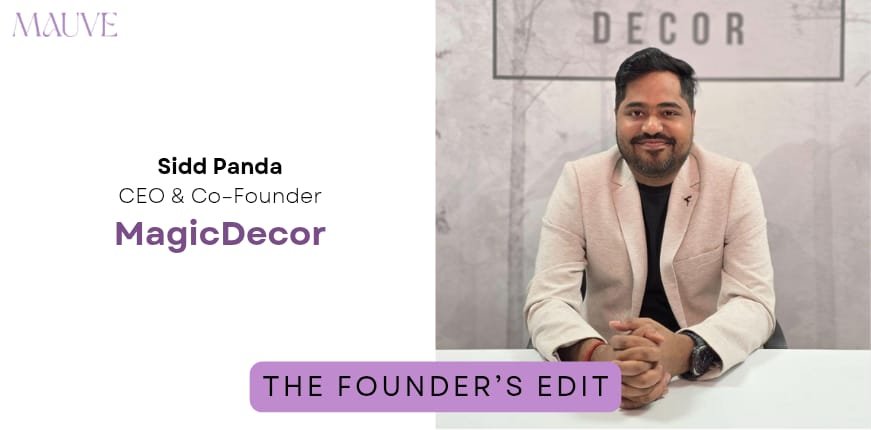
The MagicDecor Co-Founder on why customisation is replacing convention, how a pandemic strengthened his business model, and why the future of home décor belongs to technology-led creativity.
By Priya Lalwani
A home reveals more about its owner than almost anything else.
Yet for decades, the choices available to homeowners were surprisingly impersonal. Paint colours followed trends. Wallpapers came in standard patterns. Customisation often meant expensive interior designers and long project timelines.
For Sidd Panda, Co-Founder and CEO of MagicDecor, that disconnect presented an opportunity.
He believed walls could become canvases for personal expression rather than simply backgrounds.
Today, MagicDecor serves customers across more than 100 cities through a zero-inventory, made-to-order model that combines technology with design, enabling every wallpaper to be created specifically for the customer’s space.
For The Founder’s Edit, Sidd Panda reflects on building a company during one of the most uncertain periods in recent history, why personalisation is redefining Indian interiors, and how technology is quietly transforming the future of home décor.
MagicDecor was born from a simple observation.
While consumers increasingly personalised everything from clothing to entertainment, home décor remained remarkably standardised.
Wallpaper choices were often generic, expensive or difficult to customise.
Panda wanted to change that.
Instead of asking homeowners to adapt to available products, he imagined a platform where products adapted to every individual home.
Each wallpaper would be printed only after an order was placed, tailored precisely to the customer’s wall dimensions and design preferences.
Ironically, that decision became the company’s greatest strength.
MagicDecor launched in February 2020.
Within weeks, the pandemic brought supply chains to a standstill.
For many young businesses, it marked the beginning of an existential crisis.
For MagicDecor, it validated the model.
Without warehouses full of inventory, the company remained agile.
Rather than pausing growth, the team spent those months strengthening technology, refining manufacturing processes and developing digital visualisation tools that allowed customers to preview wallpapers on their own walls before ordering.
What initially seemed like devastating timing became a structural advantage.
By the time demand returned, MagicDecor had evolved into something larger than a wallpaper business.
It had become a technology-enabled personalisation platform.
The company’s rise also reflects a broader shift in Indian homes.
Wallpaper, Panda believes, is no longer merely decorative.
It has become a storytelling medium.
Today’s homeowners create reading corners, children’s bedrooms, home offices and statement walls that reflect individual personalities rather than simply following conventional design templates.
Social media has accelerated that evolution.
Global design inspiration is now accessible everywhere, encouraging consumers to think more intentionally about their living spaces.
The result is a new generation of homeowners who view interiors as an extension of identity.
That desire for self-expression extends far beyond metropolitan India.
One of the company’s most significant discoveries has been the rapid adoption of customised wallpapers across Tier II and Tier III cities.
Digital discovery has democratised design.
Consumers, regardless of geography, now draw inspiration from the same global sources while expecting personalised solutions that suit their own homes.
As logistics improve and online purchasing becomes increasingly seamless, premium design is no longer confined to urban centres.
Perhaps the biggest enabler behind this transformation has been technology itself.
MagicDecor’s entire business operates on digital precision.
Customers customise wallpapers according to exact wall dimensions.
Automated workflows process thousands of unique orders simultaneously.
Visualisation tools help eliminate uncertainty before purchase.
Artificial intelligence and design automation continue simplifying what was once a highly complex process.
Technology, Panda says, should never replace creativity.
Its role is to make creativity more accessible.
Long before MagicDecor, Panda had already built a profitable business.
While pursuing engineering, he launched Printview, eventually growing it into a ₹1 crore annual recurring revenue company.
On paper, the business was successful.
Yet something felt incomplete.
He found himself asking a far more uncomfortable question.
“Is this the legacy I want to build for the next twenty years?”
The answer surprised him.
Rather than remaining inside a business that merely functioned, he chose to leave his B.Tech programme entirely and pursue a larger vision.
For Panda, entrepreneurship was never about choosing uncertainty for its own sake.
It was about choosing conviction over comfort.
Looking back, he believes safety can quietly become a limitation.
Sometimes the greatest risk lies in never pursuing the bigger idea.
The philosophy shaping MagicDecor today remains remarkably consistent.
Personalisation is no longer treated as a premium service.
It is becoming the expectation.
Consumers increasingly want products that respond to their lifestyles rather than forcing them into predefined categories.
That mindset influences everything from the company’s manufacturing model to its expanding catalogue of nature-inspired designs, heritage motifs, children’s themes, textured finishes and customised murals.
Rather than following one dominant trend, customers now curate every room according to its purpose.
Different walls tell different stories.
The company’s made-to-order approach also reflects growing awareness around sustainability.
Traditional inventory models inevitably produce excess stock.
MagicDecor prints only after receiving confirmed orders, significantly reducing waste while allowing virtually unlimited design variety.
Efficiency and environmental responsibility, Panda believes, increasingly reinforce one another rather than compete.
Looking ahead, his ambitions extend well beyond wallpapers.
He envisions MagicDecor evolving into a comprehensive surface and spatial design platform powered by artificial intelligence.
Future systems may understand architectural layouts, individual preferences and lifestyle patterns, helping homeowners make design decisions with greater confidence.
The objective is not to overwhelm consumers with options.
It is to simplify creativity itself.
Global expansion also forms part of that vision.
As Indian manufacturing matures and demand for personalised interiors grows internationally, Panda hopes MagicDecor will represent a new generation of Indian design companies competing confidently on the global stage.
Interestingly, his own definition of success remains deeply personal.
He speaks less about scale than longevity.
Less about trends than endurance.
Building a brand, he believes, means creating something that quietly becomes part of how people tell their stories.
Not through words.
But through the spaces they choose to call home.
For Sidd Panda, walls have never been empty surfaces.
They are expressions of identity waiting to be personalised.
Ministry of Housing & Urban Affairs