
The Next Generation of Luxury Isn’t Ownership—It’s Access to Advanced Skills
For decades, luxury was defined by what people owned. Today, it is increasingly shaped by what people know.
In an economy driven by artificial intelligence, robotics and automation, access to future-ready skills has become one of the most valuable forms of capital. Technologies once reserved for defence, aerospace and large enterprises are rapidly becoming tools for entrepreneurship, agriculture, logistics and public infrastructure.
Drones perfectly embody this transformation.
No longer viewed as niche gadgets or aerial cameras, they are becoming critical infrastructure for industries ranging from precision farming and disaster management to surveying and healthcare. And as India’s drone economy accelerates, the country’s biggest opportunity may not lie in manufacturing drones alone—but in creating the skilled workforce capable of operating them.
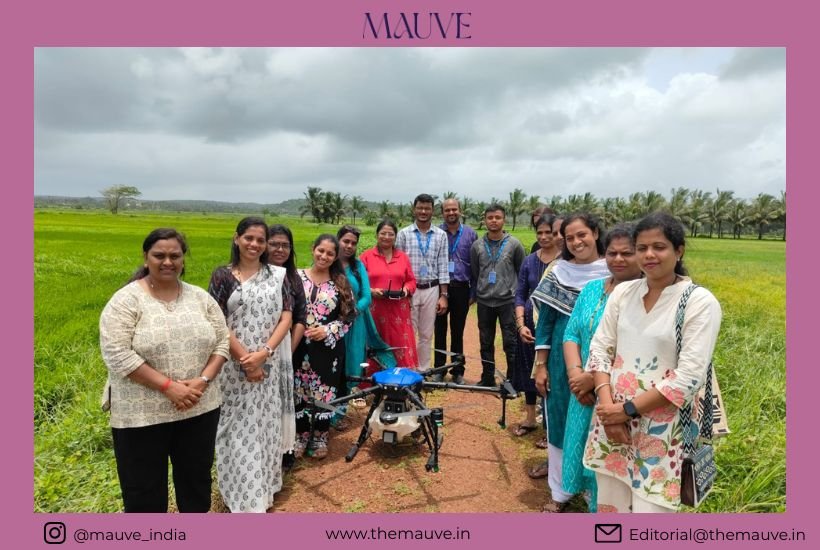
It is against this backdrop that MS Dhoni-backed Garuda Aerospace has partnered with the Goa Information Technology Development Corporation (GITDC) and the Department of Information Technology, Electronics & Communications (DITE&C) to strengthen the government’s Drone Didi initiative—an ambitious programme aimed at training 100 women every financial year and creating 300 certified women drone pilots over the next three years, subject to state approval.
Technology Meets Economic Independence
One of the defining characteristics of India’s digital transformation has been its ability to democratise technology.
The Drone Didi initiative reflects this philosophy by moving beyond awareness towards employability.
The programme is designed not simply to teach women how to fly drones but to create technology professionals capable of participating in emerging industries as certified operators, service providers and entrepreneurs.
The initiative’s first cohort—recognised by Goa’s IT Minister as the “Special 12”—received intensive training covering drone assembly, flight simulation, maintenance, aviation safety protocols and practical flying. Their live demonstrations marked more than the completion of a training programme; they symbolised a changing perception of who participates in India’s technology economy.
Building the Workforce Behind India’s Drone Revolution
India’s drone sector is evolving from experimentation to large-scale commercial adoption.
As government programmes encourage drone usage across agriculture, infrastructure, mining, logistics and public services, demand is rapidly shifting towards skilled pilots, maintenance specialists and technical operators.
Garuda Aerospace has positioned itself at the centre of this transition.
As one of India’s largest Remote Pilot Training Organisations (RPTOs), the company has established partnerships with institutions including the Rural Electrification Corporation (REIL) and multiple Farm Machinery Training & Testing Institutes (FMTTIs) to strengthen India’s drone skilling ecosystem.
Even MS Dhoni, who is both an investor and brand ambassador for Garuda Aerospace, has completed drone pilot training with the company—reinforcing the organisation’s emphasis on practical capability alongside technological innovation.
Empowering Women Through Emerging Technologies
While drones represent one of India’s fastest-growing technology sectors, initiatives like Drone Didi demonstrate that innovation can also become a powerful instrument for social inclusion.
Speaking about the partnership, Agnishwar Jayaprakash, Founder and CEO of Garuda Aerospace, said:
“The Drone Didi initiative is a powerful example of how technology can become an enabler of economic independence and social transformation. By equipping women with certified drone skills, we are enabling them to become technology users, service providers and entrepreneurs in their own right.”
His remarks reflect a broader shift taking place across India’s innovation ecosystem—where technology is increasingly measured not only by capability but by the opportunities it creates for communities.
A Larger Vision for Inclusive Innovation
Garuda Aerospace’s commitment extends beyond Goa.
The company has announced plans to expand similar skilling initiatives for widows and wives of armed forces personnel, providing free drone pilot training to enable technology-led livelihood opportunities.
Its broader impact already reflects significant scale.
In 2024 alone, Garuda Aerospace:
- Trained more than 500 rural women in drone technology.
- Delivered 446 drones to women-led Self-Help Groups across 20 states under initiatives including the Namo Drone Didi Yojana.
- Created over 3,500 jobs, spanning drone pilots, technicians and allied technology roles.
These numbers illustrate that drone technology is becoming more than an innovation story—it is increasingly an employment and entrepreneurship story.
Why Drone Skills May Become the New Competitive Advantage
Every technological revolution creates a new category of professionals.
The industrial revolution created engineers. The internet created software developers. Artificial intelligence is producing prompt engineers and AI specialists.
India’s expanding drone economy is now creating another generation of skilled professionals.
As drones become embedded within agriculture, infrastructure, logistics, environmental monitoring and emergency response, certified operators will likely become as essential as machine operators once were.
For young professionals—and increasingly for women in rural India—learning to operate advanced technologies may become one of the most valuable career investments of the coming decade.
⸻
The Mauve Perspective
The true measure of innovation isn’t the sophistication of a technology—it’s the number of lives it can transform.
Garuda Aerospace’s partnership with the Government of Goa demonstrates that India’s drone revolution is no longer solely about hardware or aviation. It is about creating a workforce capable of participating in the country’s next wave of economic growth.
In an age where luxury increasingly means access to knowledge, opportunity and future-ready skills, programmes like Drone Didi represent a different kind of aspiration.
Not one defined by ownership.
But by empowerment.

 DanielKal says:
  ManuelTrasy says:
  DanielKal says:
  DerGUM says: