From Aishwarya Rai Bachchan’s regal couture to Janhvi Kapoor’s reimagining of the Indian saree, Paris Fashion Week 2026 is witnessing a new kind of Indian fashion statement—one that knows its heritage and isn’t afraid to experiment.
By The Mauve Desk
Paris has always had a particular way of turning fashion into theatre. This season, Indian celebrities are giving that theatre a distinctly homegrown perspective.
At Paris Fashion Week 2026, Bollywood’s relationship with global fashion feels less like an exercise in dressing for the occasion and more like an evolving conversation about identity, craftsmanship and personal style. There is the unapologetic grandeur of Aishwarya Rai Bachchan, the contemporary experimentation of Janhvi Kapoor and a growing interest in the ways Indian design can hold its own on an international stage.
The result is a compelling mix of couture drama, modern silhouettes and cultural references that travel far beyond the runway.
Here are the fashion moments making the case for India’s growing presence in the global style conversation.
1. Aishwarya Rai Bachchan: The Art of Making an Entrance
The look: Regal couture with a theatrical edge
Some women wear an outfit. Others build an entire moment around it. Aishwarya Rai Bachchan has long understood the difference.
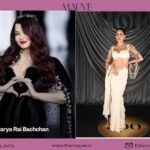
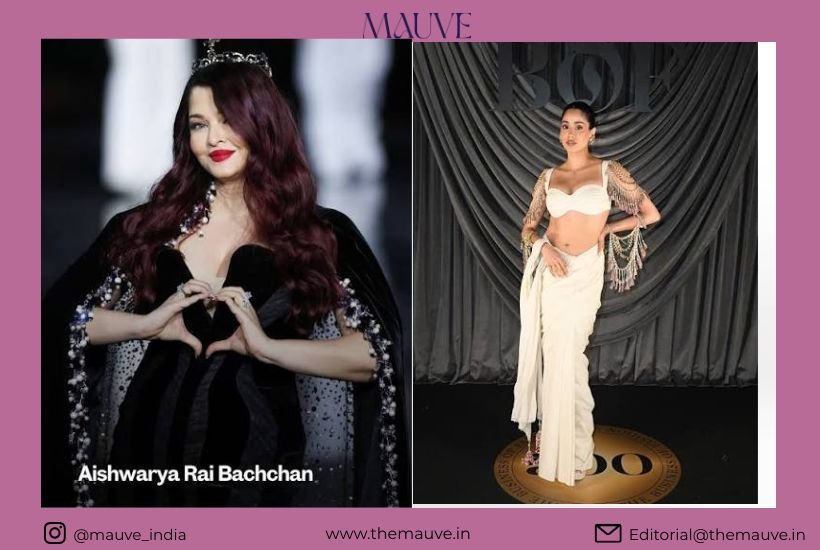
For L’Oréal Paris’s Le Défilé at Paris Fashion Week, the actor stepped onto the runway in a dramatic black velvet creation by Yara Shoemaker. A crystal-embellished cape, a statement tiara and her striking burgundy-red hair completed an appearance that leaned into the theatrical possibilities of couture.
The silhouette was unapologetically regal, but its appeal lay in the commitment to the idea. The velvet established depth, the embellishments introduced movement and the tiara pushed the styling towards fashion fantasy.
In a fashion landscape often dominated by quiet luxury and pared-back dressing, Aishwarya’s appearance was a reminder that extravagance still has a place when it is worn with conviction.
The Mauve take: Personal style does not always need to be understated to be sophisticated. Sometimes, the statement is the point.
2. Janhvi Kapoor: When the Saree Becomes a Global Conversation
The look: Contemporary Indian craftsmanship
If Aishwarya’s Paris appearance was about grandeur, Janhvi Kapoor’s was about the possibilities of reinvention.
At the Business of Fashion BoF 500 Gala in Paris, Janhvi wore a custom ivory ensemble by Pankaj S Heritage, styled by Rhea Kapoor. Crafted from 460-count Bengal muslin, the look reinterpreted the traditional saree through a low-slung drape, exposed shoulders and a floor-skimming pallu.
The textile was the quiet hero. Bengal muslin, celebrated for its exceptional fineness and delicate character, gave the ensemble a sense of lightness. Against the restrained ivory base, handcrafted embellishments featuring gold beads, pearls, shells, emeralds, polkis and tassels introduced a more expressive dimension.
Rather than treating Indian dressing as a nostalgic reference, the look placed its craftsmanship at the centre of a contemporary international fashion moment.
Janhvi also attended Miu Miu’s Spring/Summer 2027 show in a more playful, autumn-inspired ensemble featuring a multicoloured patterned skirt, a textured jacket, boots and a miniature handbag. The contrast between the two appearances demonstrated the versatility of her Paris wardrobe.
The Mauve take: Heritage becomes especially compelling when it is allowed to evolve. Janhvi’s saree was not simply a traditional garment transported to Paris; it was Indian textile artistry interpreted for a global fashion audience.
3. The Miu Miu Front Row: Janhvi Kapoor Embraces Fashion’s Playful Side
The look: Pattern, texture and deliberate contrast
Janhvi’s appearance at Miu Miu offered a different reading of her fashion sensibility.
The coordinated look combined a textured jacket with a colourful patterned mini skirt, a printed cropped top, brown boots and a miniature Miu Miu bag. Earthy tones met contrasting prints, creating an ensemble that felt intentionally eclectic rather than conventionally polished.
This is precisely where Miu Miu’s fashion language becomes interesting: the clothes often borrow from familiar wardrobes but introduce unexpected proportions, textures and combinations. The result sits somewhere between the everyday and the experimental.
Janhvi’s association with the Italian luxury house has given her opportunities to explore this aesthetic, and the Paris appearance continued that conversation.
The Mauve take: The most interesting wardrobes are rarely built around one fixed aesthetic. They make room for contrast, curiosity and the occasional unexpected pairing.
4. Indian Textiles Take Centre Stage
Beyond the celebrity photographs and front-row appearances, one of the most meaningful aspects of Paris this season is the attention being drawn to Indian craftsmanship.
Janhvi’s Bengal muslin ensemble demonstrates how textile heritage can become the foundation of a contemporary luxury look. The fabric, draping and jewellery were not incidental details; together, they formed the central narrative of the outfit.
This matters because the international fashion conversation is increasingly interested in provenance, artisanal skill and the stories behind what we wear. Indian textiles have centuries of history, but their relevance does not depend on looking traditional.
They can be sculptural, minimal, experimental or extravagant. They can work with unconventional jewellery, modern draping and contemporary styling without losing the character that makes them distinctive.
The opportunity for Indian fashion lies in making this craftsmanship visible while allowing designers and wearers to reinterpret it on their own terms.
5. Aishwarya and Janhvi Represent Two Different Ideas of Glamour
What makes these two appearances particularly interesting is how differently they approach the idea of making an impression.
Aishwarya’s look was built around spectacle. Rich velvet, sparkling embellishments and a tiara created a dramatic visual identity that embraced the traditions of red-carpet glamour.
Janhvi’s saree, by contrast, allowed the textile and its contemporary construction to carry the story. Its impact came from the relationship between delicacy and detail, heritage and reinvention.
Neither approach is inherently more fashionable than the other. They simply demonstrate that Indian celebrity style does not have to fit into a single visual category to be internationally relevant.
One celebrates the power of fashion fantasy. The other highlights the possibilities of cultural craftsmanship.
Together, they reveal a more expansive understanding of Indian glamour.
The Bigger Picture: Bollywood’s Fashion Identity Is Evolving
International fashion weeks have long offered Indian celebrities a platform to engage with the world’s most influential luxury houses. But the conversation is becoming more nuanced.
The appeal is no longer limited to wearing a recognisable designer label or appearing on a prestigious front row. What increasingly distinguishes a fashion moment is the story behind it: the choice of textile, the interpretation of a silhouette, the relationship between a celebrity and a designer, and the ability of an outfit to express something beyond the season’s prevailing trends.
Paris Fashion Week 2026 offers two particularly clear examples. Aishwarya Rai Bachchan demonstrates the enduring appeal of dramatic couture, while Janhvi Kapoor brings Indian textile craftsmanship into a contemporary international setting.
For Indian fashion, this creates an opportunity to participate in global conversations without abandoning its own vocabulary.
Because the most compelling fashion statements do not simply ask to be noticed. They give the audience something worth looking at twice.
The Mauve Verdict
Paris may provide the runway, but the most interesting fashion stories are the ones that travel with their own point of view.
This season, Bollywood’s style conversation moves between couture theatre and textile heritage, between the pleasure of dressing up and the deeper story of how clothing carries culture.
And that is what makes these appearances worth watching: not simply that Indian stars are in Paris, but that they are arriving with distinctly different ideas of what Indian glamour can look like.
The Mauve Edit: Fashion is at its most powerful when it knows where it comes from—and where it wants to go.
Editorial note: This article is an independently written fashion feature based on publicly reported Paris Fashion Week 2026 appearances. It is not affiliated with or endorsed by the designers or brands mentioned.