Some photographs document history.
Others become part of it.
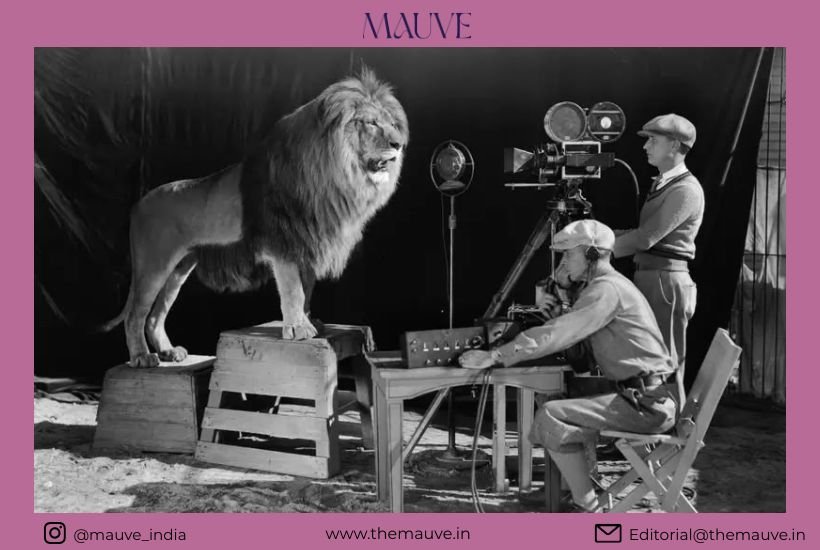
The iconic behind-the-scenes image of Jackie, the lion immortalised in Metro-Goldwyn-Mayer’s legendary opening logo, belongs firmly to the latter category. But while the MGM lion became one of cinema’s most recognisable symbols, the man behind the camera is far less remembered.
His name was Fred A. Parrish.
A Hollywood still photographer with an inventor’s mind and an extraordinary eye for the theatre of filmmaking, Parrish captured more than a lion roaring into the camera. He documented a moment when cinema itself was changing—and, in doing so, created an image that would outlive the studio era that produced it.
⸻
Before the Roar Became Sound
The MGM lion had already appeared on screen before Jackie.
The first MGM lion, Slats, appeared during the silent-film era. But when cinema began finding its voice, MGM needed something more than a visual emblem.
Enter Jackie.
For the studio’s early talking pictures, Jackie’s recorded growls and roars were played through a gramophone, giving MGM’s opening logo a new dimension.
To capture the sound, crew members established a soundstage and recording equipment only a few feet from the lion’s enclosure, working alongside animal trainer Mel Koontz.
The result was one of Hollywood’s most enduring introductions: a lion’s roar announcing the beginning of an MGM film.
⸻
Meet Jackie, Hollywood’s Lucky Lion
Jackie featured in the MGM opening logo from 1928 to 1956.
But his Hollywood career was remarkable for another reason.
He survived a series of extraordinary disasters—including multiple train wrecks, an earthquake and a plane crash.
The near-mythical survival record earned him the nickname:
“Leo the Lucky.”
For audiences, Jackie became the face of MGM.
For the people behind the scenes, however, photographing and filming the animal presented an entirely different challenge.
And that is where Fred A. Parrish enters the frame.
⸻
Fred A. Parrish: The Photographer Who Saw Hollywood Differently
Parrish was not simply a man who stood behind a camera.
He was an inventive Hollywood still photographer who understood that filmmaking happened beyond the frame of the finished movie.
He developed a reputation for capturing the people, machinery, sets and fleeting moments that audiences never saw.
His work belonged to the world behind the spectacle.
And he approached photography with the technical curiosity of an inventor.
⸻
The Camera He Changed Himself
One of the most fascinating aspects of Parrish’s career was his experimentation with camera technology.
He developed a special modification that allowed 35mm movie film to be used for individual high-quality still photographs.
At a time when photography demanded considerable technical precision, this kind of innovation gave him greater flexibility on set.
He was also known for his mastery of hand-cranked cameras and the concentration required to make a sharp image using early photographic equipment.
The camera may have been mechanical.
The eye behind it wasn’t.
⸻
The Photographer of Hollywood’s Hidden Moments
Parrish eventually became closely associated with legendary producer David O. Selznick, becoming a key photographer during one of Hollywood’s most important eras.
His most celebrated assignment came with Gone with the Wind (1939).
As the film was being made, Parrish photographed the production extensively, creating a remarkable visual record of the enormous sets, performers and filmmaking process.
His archive reportedly included more than 2,500 large photographs and 4,000 smaller photographs from the production.
But numbers alone don’t explain his significance.
His photographs captured something the finished film couldn’t:
the making of the movie.
⸻
The Stories That Never Made It to the Screen
Film audiences see the final cut.
Photographers like Parrish preserved everything around it.
His behind-the-scenes images documented scenes, sets and moments that didn’t necessarily survive into the finished film.
Some were cut.
Some were altered.
Some existed only briefly during production.
Through photography, they survived.
This is what makes Hollywood still photography so important to the history of cinema. A film tells us what the filmmakers ultimately chose to show.
A still photographer can tell us how that world came into existence.
⸻
From the MGM Lion to Gone with the Wind
The photograph associated with Jackie represents an earlier chapter of Parrish’s career, when Hollywood was establishing the visual language that would define the studio system.
Later, his work on Gone with the Wind placed him inside one of the most ambitious productions of its era.
The connection between the two isn’t simply Hollywood glamour.
It is documentation.
Parrish was photographing the machinery behind mythology.
The lion.
The stars.
The sets.
The technicians.
The moments between takes.
The spectacle before the audience ever saw it.
⸻
A Photographer Who Refused to Stay Inside the Frame
Parrish’s career eventually extended beyond Hollywood.
Later in life, he travelled to photograph during the Korean War, taking his camera far beyond the studio environments that had defined his earlier work.
Before his death in 1980, he was reportedly working on a comprehensive book documenting the history of Hollywood’s golden age.
His photographic equipment—including his original custom box camera, tripods and other gear—is preserved by the Culver City Historical Society.
In a way, it is a fitting legacy.
The photographer who spent his career preserving Hollywood’s visual memory ultimately left behind the very tools with which he created it.
⸻
THE ART VAULT
Fred A. Parrish
Hollywood Still Photographer
Known for: MGM’s Jackie imagery, Gone with the Wind, Hollywood production photography
Era: Hollywood’s Golden Age
Legacy: Behind-the-scenes documentation, photographic innovation and visual preservation of classic Hollywood
⸻
The Mauve Perspective
The MGM lion is remembered because it roared.
Fred A. Parrish deserves to be remembered because he looked.
His photographs remind us that cinema history isn’t made only by actors, directors and studios. It is also preserved by the people standing just outside the frame, watching carefully enough to understand that the moment in front of them might someday become history.
Jackie became an icon.
MGM became a legend.
Gone with the Wind became cinematic history.
And somewhere behind those images stood a photographer with a camera, a steady hand and the instinct to preserve what the audience wasn’t meant to see.
That is the quiet power of the still photograph.
It doesn’t merely capture a moment.
It keeps the moment from disappearing.