
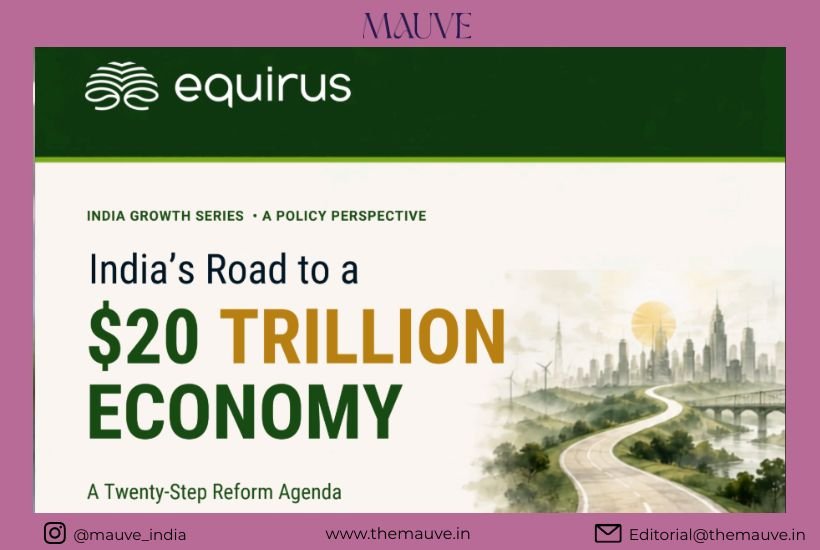
The target is a fivefold leap in a decade. Reaching it will depend less on the
number than on twenty reforms — most of them already within the government’s
own toolkit.
By Ajay Garg and Khushali Dutt
Ajay Garg is Chairman & Managing Director of Equirus Capital. Khushali Dutt is an Associate Economist at Equirus
Securities.
India took 67 years to build its first $2 trillion of GDP. It added the next $2 trillion in barely a
decade. The ambition now on the table — a $20 trillion economy by 2036 — asks the country to
grow roughly five times over in a little more than ten years. It can be done: China sustained close
to 18% nominal dollar growth for eleven straight years from a comparable base. But a leap of this
size will be decided less by the target itself than by the quality of the reforms that clear the path to
it. How India grows will matter as much as how fast.
India’s GDP milestones — and the scale of the leap the $20tn target implies.
How the economy grows, not just how fast
Start with the shape of the economy, not just its size. Agriculture, about 17% of GDP, will keep
shrinking as a share as the country urbanises. Manufacturing, at 17–20%, is largely capped by a
more protectionist world. That leaves services — already 54% of GDP — to do the heavy lifting,
rising past 65% and expanding from roughly $2 trillion to more than $11 trillion. Almost every
reform worth making is, in one way or another, about clearing the path for that expansion.
Mature economies run on services. India’s target composition leans the same way.
Twenty reforms, five engines
The reforms fall into five engines that must fire together. In the real economy, the quickest wins
cost the exchequer almost nothing. A ten-year tax holiday for cold storage would attack a
threadbare cold chain — only about 4% of India’s fruit and vegetables travel refrigerated, against
80–85% in the United States — and reclaim a share of the roughly 50 million tonnes of
horticulture lost every year. A mandatory floor on state capital spending, after states left about
₹2.3 trillion of budgeted capex unspent in FY26, could add close to ₹5.2 trillion to GDP without
a rupee of new borrowing. And listing the Railways would free the roughly ₹2.8 trillion of
taxpayer capital it absorbs each year.
In the capital markets, the theme is unlocking trapped money. An India Sovereign Fund on
Singapore’s Temasek model could pool the roughly $249 billion of equity the government holds
across public-sector companies into one professionally run vehicle, throwing off proceeds to fund
capex and subsidies without new taxes or debt. Levelling the tax treatment of bonds and equity
would begin to deepen a corporate bond market that sits at just 18% of GDP against 130% for
equities. And a cluster of tax reforms — abolishing advance tax, cutting withholding to a flat 5%,
ending the double transaction tax on shares — would release trapped working capital and bring
India into line with global norms.
In human capital, the through-line is capacity. India’s education funnels are brutally narrow:
around 187,000 students sit JEE Advanced for some 18,000 IIT seats, while hundreds of
thousands head abroad for undergraduate STEM. The telecom template is instructive — once
private capital was let in, access exploded and prices collapsed — and the same playbook can build
education capacity at scale. Reviving private research (India spends just 0.8% of GDP on R&D,
the lowest in its peer group), funding universities on outcomes rather than headcount, and
reviving apprenticeships complete the agenda.
In services — India’s quiet superpower — the country already hosts more than 1,800 Global
Capability Centres, about half the world’s total. A single empowered National GCC Policy could
push that toward 5,000. Scaling a tiny tourism-promotion budget and turning prime-ministerial
visits into structured trade-and-tourism missions cost next to nothing.
India already hosts about half the world’s GCCs — a National GCC Policy could take it to 5,000 by 2030.
And in liveability and governance — because a $20 trillion economy has to be livable —
putting air pollution on a war footing, where 42 of the world’s 50 most-polluted cities are Indian,
and giving cities a directly elected, accountable mayor.
Does it add up? It pays for itself
The obvious objection to a package this size is cost. On our accounting, it more than pays for itself
in the very first year: roughly ₹3.4 trillion of direct costs against about ₹7.9 trillion of direct
gains — a net gain of some ₹4.5 trillion, or a 2.3x return. And much of the apparent “cost” is not
revenue foregone at all. Abolishing advance tax or cutting withholding does not reduce what is
ultimately owed; it only shifts the timing. The tax is still paid at filing. What changes is that vast
sums of trapped working capital are released back into the economy.
The currency does part of the work
Because the target is denominated in dollars, the exchange rate carries part of the load. The
reforms are built to lift rupee growth from a trend of about 10.5% toward roughly 14% — and, by
improving the balance of payments, to turn the rupee’s structural depreciation into modest
appreciation. Growth in rupees, plus a firmer currency, is what bridges the final distance to $20
trillion in dollars.
None of this rests on a single lever. It rests on twenty of them reinforcing one another — and,
crucially, on the fact that most are already within the government’s own toolkit. They need a
change in law or administration more than they need new money, and several of the highest-
impact moves cost the exchequer almost nothing while freeing enormous amounts of trapped
capital and fiscal space. The target is unapologetically ambitious. But the path to it is more
available than the scale of the number suggests.
“The way the economy grows will matter just as much as how fast.”