
By Diksha Bhardwaj, Co-Founder, The Orange Skincare
Prepared for The Mauve · 4 November 2026
As temperatures drop across North India, most of us reach for our woollens and forget that our skin needs a change of wardrobe too. Cold air holds less moisture, heaters and hot showers strip away what little is left, and chilly winds do the rest. The result is familiar: tight, flaky cheeks, chapped lips, dull patches and, for many, sudden sensitivity to products that worked perfectly in summer.
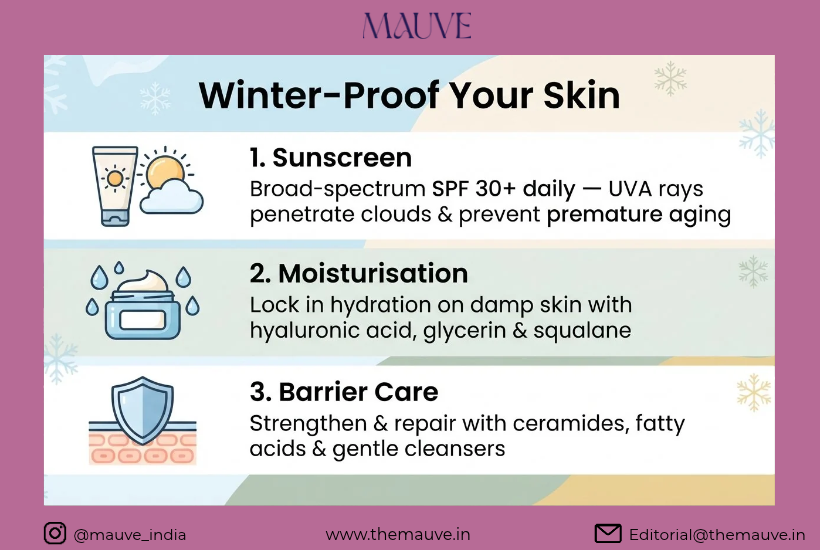
The good news is that winter skincare doesn’t need a cabinet full of new products. It rests on three simple pillars: sunscreen, moisturisation and barrier care. Get these right, and your skin can stay calm, comfortable and healthy right through to spring.
Sunscreen: Not Just a Summer Habit
The most common winter myth is that sunscreen can be packed away with the summer clothes. The sun may feel gentler, but UV exposure doesn’t take a holiday. UVB rays, which cause burning, do dip in winter. UVA rays, which drive tanning, pigmentation and premature ageing, stay fairly steady through the year and pass through clouds, fog and window glass.
Winter sun is also deceptive. We spend long afternoons soaking it up on terraces, in parks and at weddings, often for hours at a stretch, and those warm, lazy hours add up. Heading to the hills? Fresh snow can reflect up to 80% of UV rays, nearly doubling your exposure.
Choose a broad-spectrum sunscreen of SPF 30 or higher, with a PA+++ or higher rating for UVA protection. Use about two finger-lengths for the face and neck as the last step of your morning routine, and reapply every two to three hours when you’re outdoors. In winter, a formula with hydrating ingredients such as ceramides does double duty, shielding the skin while helping it hold on to moisture.
Moisturisation: Layer Smart, Not Heavy
In dry weather, water evaporates from the skin faster than usual. Dermatologists call this transepidermal water loss, and it is the main reason winter skin feels tight. A good moisturiser tackles it in three ways: humectants such as glycerin and hyaluronic acid draw water into the skin, emollients such as squalane smooth rough patches, and occlusives such as shea butter form a light seal that slows water loss.
Timing matters as much as texture. Apply moisturiser within a minute or two of washing your face, while the skin is still slightly damp, to lock that water in. If you have oily or acne-prone skin, don’t skip this step; a lightweight gel-cream is enough, and dehydrated skin often responds by producing more oil. Dry skin can move to a richer cream at night. And don’t forget the neck, hands, lips and the area around the eyes, which tend to dry out first.
Barrier Care: The Foundation of Healthy Skin
Think of your skin barrier as a brick wall. Skin cells are the bricks, and lipids such as ceramides, cholesterol and fatty acids are the mortar holding them together. When winter dryness, harsh cleansers or over-exfoliation weaken that mortar, moisture escapes and irritants get in. That is when redness, stinging and unexpected breakouts appear.
To keep your barrier strong this season:
- Switch to a gentle, non-foaming cleanser and wash with lukewarm, not hot, water.
- Limit scrubs and strong exfoliating acids to once a week, or pause them if your skin stings.
- Introduce potent actives like retinoids slowly, and buffer them with moisturiser.
- Look for barrier-friendly ingredients: ceramides, niacinamide, panthenol and centella asiatica.
- Run a humidifier in heated rooms and keep up your water intake through the day.
A Simple Winter Routine
Morning: gentle cleanser, a hydrating serum if you use one, moisturiser, then broad-spectrum sunscreen.
Night: gentle cleanser, your treatment step used sparingly, then a richer moisturiser or night cream.
Winter skincare is less about doing more and more about doing the basics consistently. Protect your skin from the sun every single day, keep it well hydrated, and treat your barrier with care. If dryness, itching or redness persists despite a good routine, consult a dermatologist, as it may point to a condition such as eczema that needs proper treatment.
Diksha Bhardwaj is the Co-Founder of The Orange Skincare, a homegrown Indian skincare brand.