From a 75-day celebration of indigenous faith in Bastar to Mysuru’s royal pageantry, Kolkata’s emotional farewell to Durga and the Himalayan gathering of village deities, Vijayadashami reveals a country united by celebration yet distinct in its traditions.
By The Mauve Desk
There is a moment every year when the familiar imagery of Dussehra takes over the Indian imagination: towering effigies against the evening sky, crowds gathered in anticipation, the crackle of fireworks and the symbolic triumph of good over evil.
Yet, beyond the spectacle of Ravana Dahan lies a far more intricate cultural landscape.
In one part of the country, a wooden chariot becomes the centre of a festival that stretches across 75 days. In another, a royal procession honours a powerful goddess. Elsewhere, families exchange leaves as gold, children take their first steps into the world of letters, and communities gather to bid farewell to an elaborately crafted idol.
Dussehra, Vijayadashami and the culmination of Navratri are not experienced through a single narrative. Their meanings shift with geography, local histories, religious traditions and the communities that have preserved them across generations.
Across India, the festival becomes a reminder that cultural unity does not require uniformity.
Bastar: A Dussehra That Does Not Burn Ravana
In Bastar, Chhattisgarh, Dussehra follows a story that differs significantly from the familiar account of Lord Rama’s victory over Ravana.
Here, the festival is centred on Maa Danteshwari, local deities and the indigenous religious traditions of the region. Believed to date back approximately six centuries, Bastar Dussehra unfolds over around 75 days, bringing together communities, traditional institutions and sacred processions.
The festival begins with Pat Jatra, a ritual associated with the worship of wood used in constructing the ceremonial chariot. As the celebrations progress, a succession of rituals leads to the gathering of deities and the much-anticipated chariot processions in Jagdalpur.
Its significance extends beyond the visible grandeur of the festival. The participation of local communities, the knowledge involved in traditional chariot-making and the continuity of regional customs make Bastar Dussehra a living expression of cultural heritage.
The absence of Ravana Dahan is not a missing element in the celebration. It reflects a different religious and cultural emphasis altogether.
In a country where the same festival can carry different meanings, Bastar offers a compelling reminder that traditions deserve to be understood on their own terms.
Mysuru: Where Dasara Wears Its Royal Heritage
In Mysuru, Karnataka, Dussehra unfolds with the grandeur of a royal festival.
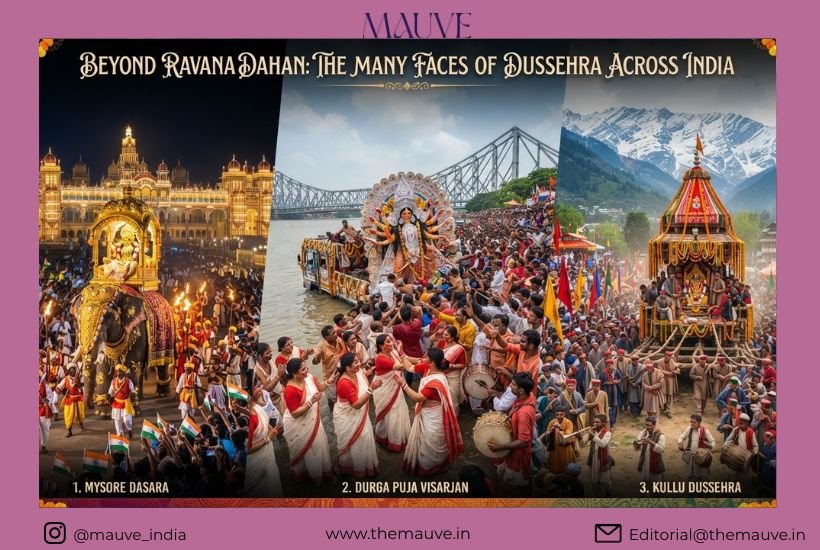
Known as Mysuru Dasara, the celebration honours Goddess Chamundeshwari and her victory over Mahishasura, a legend closely associated with the city’s identity. The illuminated Mysuru Palace becomes a defining image of the season, while cultural performances, ceremonial traditions and the celebrated Jumboo Savari procession bring the city together.
The procession, featuring the deity of Chamundeshwari in a golden howdah, is among the festival’s most recognisable spectacles.
Yet the appeal of Mysuru Dasara lies not only in its visual splendour. It is also a story of heritage, patronage, public celebration and the ways in which historical traditions continue to shape a modern city’s cultural identity.
Here, Vijayadashami is both a religious observance and a carefully preserved expression of royal history.
Kullu: When the Gods Gather in the Valley
In Himachal Pradesh’s Kullu Valley, Dussehra has a rhythm of its own.
While festivities in many parts of India conclude on Vijayadashami, Kullu Dussehra begins on the day itself. The celebrations centre on Lord Raghunath, accompanied by the arrival of hundreds of local deities carried in decorated palanquins from surrounding villages.
At Dhalpur Maidan, these deities gather amid traditional music, processions and ceremonial observances. The result is a festival shaped by the religious life of the valley and the relationships between its villages, deities and custodians.
The gathering offers a glimpse into a cultural system in which local deities remain an important part of community identity.
For Kullu, Dussehra is not simply an occasion to mark a mythological victory. It is also a meeting of traditions, bringing together the spiritual and social worlds of the Himalayan region.
Kolkata: The Art of Saying Goodbye to Durga
In West Bengal, the emotional heart of the festive season lies in Durga Puja and its culmination on Bijoya Dashami.
After days of elaborate pandals, artistic installations, devotional rituals and community gatherings, Vijayadashami marks the farewell to Goddess Durga. Sindoor Khela, observed by women in many communities, and the immersion of idols are among the day’s defining traditions.
There is a particular poignancy to this farewell. The Goddess who has occupied the centre of public and domestic celebration is prepared for her departure, bringing the festivities to a close while leaving behind the anticipation of her return the following year.
The rituals also reveal the extraordinary relationship between art and devotion in Bengal. The making of idols, the imagination behind pandal design and the collective effort involved in organising Puja turn the festival into a vast cultural undertaking.
Bijoya Dashami is therefore both an ending and a promise: a farewell that already carries the hope of reunion.
Delhi: The Enduring Theatre of Good Over Evil
In Delhi, Dussehra remains closely associated with Ramlila and Ravana Dahan.
Across the capital, performances of the Ramayana bring its characters and episodes to life through theatre, music, elaborate costumes and community participation. The festivities culminate in the burning of effigies of Ravana and, in many celebrations, Meghnad and Kumbhakarna.
The spectacle may last only a few moments, but the work behind it begins much earlier. Performers rehearse, craftspeople construct the effigies, organisers coordinate public gatherings and communities return to traditions that have become part of their annual calendar.
Delhi’s Dussehra is a story of public performance as much as religious celebration. It demonstrates how an epic can continue to inhabit contemporary urban life through shared storytelling.
Maharashtra: When Leaves Become Gold
Not every Dussehra tradition relies on a grand procession or a public spectacle.
In Maharashtra, many communities observe the custom of exchanging Apta leaves as symbolic gold. Friends, relatives and neighbours exchange the leaves with wishes for prosperity and good fortune. Shami worship and the symbolic crossing of boundaries, known as Seemollanghan in some traditions, may also form part of the observance.
The gesture is modest, but its symbolism is enduring. Prosperity is communicated through an exchange between people, turning an ordinary leaf into a token of affection, goodwill and abundance.
It is a reminder that some of India’s most meaningful festive customs are carried not by spectacle, but by the small rituals repeated between generations.
Tamil Nadu: A Festival Told Through Dolls
In Tamil Nadu, the tradition of Bommai Golu brings storytelling into the home.
During Navratri, families arrange dolls on stepped displays, representing deities, mythological narratives, social scenes and aspects of everyday life. The arrangements can be elaborate, with collections passed down through generations and expanded over time.
Inviting guests to view the display, sharing traditional offerings and participating in devotional observances turn Golu into a social as well as religious tradition.
The dolls become a medium through which stories are preserved and reinterpreted. Mythology, art, memory and domestic creativity coexist on the same steps.
It is an intimate expression of festive culture, where the home becomes a space for storytelling.
Kerala: Where Vijayadashami Begins With Learning
In Kerala, Vijayadashami is associated with Vidyarambham, the initiation of children into learning.
In a ceremony often marked by the guidance of a teacher or elder, children are introduced to writing their first letters. The act represents more than the beginning of formal education. It carries the hope that learning will become a lifelong pursuit.
The tradition lends Vijayadashami a meaning that reaches beyond the familiar imagery of victory and spectacle. Here, the festival is also about possibility: the beginning of a child’s intellectual journey and the value a community places on knowledge.
It is a quiet but powerful expression of renewal.
Gujarat and Telangana: Celebrating the Goddess Through Community
In Gujarat, the nights of Navratri are transformed by Garba and Dandiya Raas. Devotion to the Goddess finds expression through circular dances, rhythmic music and traditional attire, bringing communities together in celebrations that combine spirituality with social participation.
In Telangana, Bathukamma offers another distinctive expression of the festive season. Women gather around colourful arrangements of seasonal flowers, singing traditional songs and participating in rituals associated with the Goddess and the region’s cultural relationship with nature.
The two traditions differ in form, but both demonstrate how festive observance can become a collective cultural expression. Dance, flowers, music, clothing and shared participation give religious traditions a public and distinctly regional character.
The Many Meanings of Vijayadashami
Across these celebrations, several interpretations of the festive season emerge.
For some, Dussehra marks Lord Rama’s victory over Ravana. For others, Vijayadashami celebrates the power of the Goddess. In Bastar, it brings indigenous deity traditions and community rituals into focus. In Kerala, it marks the beginning of learning; in Maharashtra, a gesture of prosperity is shared through leaves.
These traditions should not be reduced to interchangeable versions of a single celebration. Each has its own history, religious framework and local significance.
Together, however, they reveal a shared cultural instinct: to gather, remember, renew and pass something meaningful to the next generation.
One Festival, Many Indias
Perhaps the most revealing aspect of Dussehra is not how differently it is celebrated, but what those differences tell us about India.
A festival can be a royal procession in Mysuru, a dramatic performance in Delhi, an artistic farewell in Kolkata, a gathering of village deities in Kullu or a long-standing expression of indigenous faith in Bastar.
It can unfold through the burning of an effigy, the movement of a chariot, the exchange of leaves, a display of dolls or a child’s first written letter.
Each tradition carries a distinct memory of the past while remaining part of contemporary life.
To understand Dussehra across India is to look beyond the familiar image of the festival and recognise the many communities, histories and beliefs that give it meaning.
Because sometimes, the most revealing story about a country is not the tradition it shares, but the many ways it chooses to celebrate it.
Editorial note: The regional traditions described here draw on government tourism and cultural sources, including the Ministry of Tourism’s Dussehra guide, the official Bastar Dussehra guide, and the Chhattisgarh government’s Bastar heritage page. Local practices vary, and individual customs should be verified with regional sources and community representatives before publication.