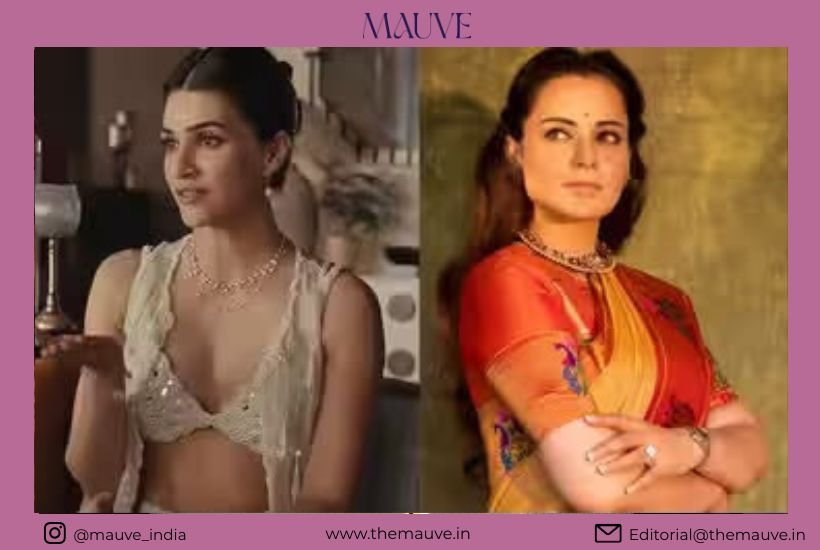
A Raksha Bandhan campaign featuring Kriti Sanon recently sparked a debate that was less about jewellery and more about what we believe Indian culture is supposed to look like.
The conversation began after Kangana Ranaut criticised the actress’s outfit in the campaign, questioning the appropriateness of the styling for a festival centred around the relationship between siblings.
But beneath the social-media debate lies a more interesting question:
When did a particular way of dressing become the definition of Indian modesty?
Because Indian clothing has never been as uniform—or as static—as we sometimes imagine.
Before the blouse, there was the drape
The sari, as we recognise it today, is the result of centuries of evolution. Ancient Indian clothing traditions included garments such as the antariya, a lower-body drape, and the uttariya, a cloth worn over the upper body or shoulders.
Depending on the period, region, community and social context, the upper body could be covered in different ways—or left partially uncovered.
The important distinction is that the absence of a modern blouse did not mean the absence of clothing.
Indian clothing historically relied heavily on draped and unstitched textiles. Clothing was adaptable, breathable and capable of being arranged according to occasion, geography and social setting.
The fitted blouse and petticoat combination that many Indians today instinctively associate with the sari became particularly prominent much later.
In 19th-century Bengal, for instance, the sari began to be worn with stitched blouses and petticoats under the influence of changing social conventions and encounters with European and Parsi styles. Jnanadanandini Devi, the wife of Satyendranath Tagore, played an important role in popularising a more structured sari drape that could be worn in public and social settings.
In other words, what feels timeless today has a history of its own.
And then there are the temples
Walk through the sculptural traditions of ancient and medieval India and the modern idea that Indian culture has always demanded complete bodily concealment becomes considerably more complicated.
From Khajuraho to other temple traditions, the human body appears repeatedly in Indian art—sometimes adorned, sometimes minimally clothed, sometimes represented in erotic poses.
These sculptures should not be reduced to evidence that ancient Indians simply “did not care about clothing.” Temple art had multiple meanings, including ideas surrounding fertility, beauty, prosperity, spirituality and human experience.
But they do tell us something important:
The human body itself was not automatically treated as incompatible with Indian artistic or cultural expression.
That is a very different cultural history from the idea that every visible inch of the body is inherently provocative.
The Kama Sutra complicates the picture even further
The Kama Sutra is another reminder that ancient Indian intellectual traditions did not treat desire, beauty and relationships as subjects that had to disappear from public consciousness.
Of course, the text cannot be used as a handbook for how every Indian dressed or behaved. Ancient India was never a single culture with a single dress code.
But its existence—and the wider artistic traditions surrounding it—does challenge the simplistic idea that Indian culture has always been defined by one rigid standard of bodily modesty.
Indian civilisation had room for aesthetics, sensuality, ornamentation and the human body.
So when did our understanding of “appropriate” Indian clothing become so narrow?
Clothing was also about climate
There is another piece of this conversation that often gets lost: India is hot.
For centuries, Indian clothing evolved around heat, humidity, movement and local textile traditions.
Cotton became deeply embedded in Indian textile culture. Draped garments allowed flexibility. Loose silhouettes allowed movement. Different regions developed their own ways of negotiating the climate.
The dhoti, sari, lungi, veshti and numerous regional garments demonstrate that traditional Indian clothing was not built around the same silhouette as contemporary Western formalwear.
That does not mean trousers, shirts, jackets or modern clothing are somehow “un-Indian.”
It simply means that Indian fashion has always adapted.
And that adaptation is precisely what fashion does.
Tradition itself has always evolved
This is perhaps the most important part of the debate.
We often speak about “traditional Indian clothing” as though someone froze Indian fashion at one particular moment in history.
But which moment?
Ancient India?
The medieval period?
The Mughal era?
19th-century Bengal?
Pre-independence India?
Post-independence India?
The answer changes everything.
A sari worn by a woman in an ancient sculpture is not necessarily styled like a sari worn by a woman in 1900, which is not necessarily styled like the sari worn by a woman today.
Tradition isn’t a photograph.
It is a continuum.
So what does this have to do with Kriti Sanon?
Everything.
Kriti Sanon’s Raksha Bandhan campaign was created within the language of contemporary fashion. Its styling was designed to look polished, glamorous and editorial.
Whether someone personally likes the outfit is entirely subjective.
But transforming a fashion choice into a statement about a woman’s character—or suggesting that a particular outfit is inherently inappropriate for the relationship between a brother and sister—opens a much larger conversation about how women’s clothing continues to be interpreted through morality.
And that is where the debate becomes uncomfortable.
Because if an outfit is considered inappropriate simply because it reveals more skin than someone personally considers acceptable, whose standard of acceptable are we applying?
And more importantly, does wearing something fashionable automatically change the meaning of a relationship?
Raksha Bandhan was never a dress code
Raksha Bandhan is about affection, protection and the bond between siblings.
Kriti Sanon herself responded by pointing towards the idea of siblings protecting one another—not towards a particular definition of what a woman should wear while celebrating the festival.
That distinction matters.
A woman can wear a sari.
She can wear a lehenga.
She can wear a blouse.
She can wear a crop top.
She can wear a contemporary interpretation of traditional clothing.
None of these choices independently determine the character of her relationship with her brother.
Clothing is not a moral certificate.
Perhaps the real tradition is change
The irony of the controversy is that Indian fashion has survived precisely because it has changed.
The sari changed.
The blouse changed.
The way women draped clothing changed.
Textiles changed.
Silhouettes changed.
Jewellery changed.
Even our definition of what looks “traditional” changed.
What we call traditional today was, at some point, contemporary.
So perhaps the more historically accurate question isn’t:
“Is this Indian enough?”
It is:
“What part of India’s incredibly diverse fashion history are we drawing from?”
Because India’s sartorial history is far larger than one blouse, one drape or one definition of modesty.
And perhaps before telling another woman what Indian culture allows her to wear, we should first remember just how many different ways Indian women have been dressing for thousands of years.
Fashion evolves. Culture evolves. And Indian fashion has never been one thing.